
Why do two different in-ear monitors with virtually identical frequency response curves on an acoustic coupler sound radically different in practice—one delivering thunderous, cohesive transient punch while the other sounds disjointed, smeared, and hollow? The hidden differentiator is not frequency magnitude; it is group delay and non-minimum phase behavior. When multi-driver … [Read more...] about Group Delay Non-Minimum Phase Behavior: IEM Phase vs. Magnitude
Blog
Crossfeed Circuit Topologies: Bauer vs. Linkwitz Binaural Simulation

Have you ever listened to classic 1960s stereo tracks like The Beatles or Jimi Hendrix through high-end headphones and felt an uncomfortable, dizzying sensation as the drums sit entirely in your left ear while the vocals are isolated in the right? In the real world, human ears never hear isolated mono channels; sound from a left speaker naturally travels across the head to … [Read more...] about Crossfeed Circuit Topologies: Bauer vs. Linkwitz Binaural Simulation
Capacitive Load Stability: Preventing Oscillation in High-Current Op-Amps

Why can plugging an expensive, ultra-thick braided audiophile headphone cable into a high-speed operational amplifier unexpectedly cause the amplifier to run scorching hot, sound mysteriously harsh, or even burn out its output stage entirely? In the physics of high-speed analog electronics, heavy multi-conductor cables carry hundreds of picofarads of parasitic capacitance. When … [Read more...] about Capacitive Load Stability: Preventing Oscillation in High-Current Op-Amps
Super-Regulator Power Supplies: Sub-Microvolt Noise in Headphone Amps
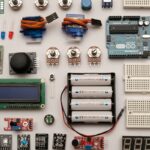
Can an audio amplifier ever sound cleaner or more transparent than the direct current (DC) power entering its transistors? In the pursuit of pure acoustic transparency, audio engineers have learned that an amplifier does not simply “boost” an incoming signal; it modulates its own DC power supply rails to recreate the musical waveform. If those power rails contain microvolts of … [Read more...] about Super-Regulator Power Supplies: Sub-Microvolt Noise in Headphone Amps
Discrete R-2R Ladder Glitch Energy: Code Transition Jitter in DACs

Why do discrete R-2R ladder DACs possess an intoxicating, analog-like musicality and visceral midrange realism that delta-sigma DACs struggle to replicate, yet often exhibit subtle high-frequency harmonic distortion spikes on oscilloscope analyzers? The culprit is an inherent physical artifact known as major carry code transition glitch energy. When a digital audio word … [Read more...] about Discrete R-2R Ladder Glitch Energy: Code Transition Jitter in DACs