
When searching for the perfect headphone amplifier, most audiophiles immediately look at specifications like power output (measured in milliwatts or watts), Total Harmonic Distortion (THD+N), signal-to-noise ratio (SNR), and output impedance. While these metrics are undeniably important, they only tell part of the story. There is a critical, often-overlooked specification that … [Read more...] about Understanding Slew Rate in Headphone Amplifiers and Why It Matters
Blog
Polyarylate (PAR) Diaphragms in Headphones: The Acoustics of Synthetic Polymer Cones

The quest for high-fidelity sound reproduction in headphones is fundamentally a search for the perfect transducer diaphragm. In dynamic driver designs, the diaphragm acts as the piston that vibrates the air, converting electrical signals into the complex acoustic waveforms that we perceive as music. To achieve this translation with absolute accuracy, audio engineers have long … [Read more...] about Polyarylate (PAR) Diaphragms in Headphones: The Acoustics of Synthetic Polymer Cones
Negative Feedback in Amplifier Circuits: Audio Purification or Lifeless Sound?
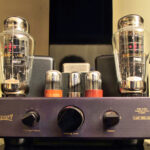
In the world of high-fidelity audio, few topics spark as much heated debate as the use of negative feedback (NFB) in amplifier design. For decades, engineers and audiophiles have been locked in a classic struggle. On one side, proponents argue that negative feedback is the ultimate tool for audio purification, correcting circuit non-linearities, and flattening frequency … [Read more...] about Negative Feedback in Amplifier Circuits: Audio Purification or Lifeless Sound?
The Physics of Output Transformers in Tube Amplifiers: OTL vs. Transformer-Coupled
For decades, audiophiles have chased the warm, three-dimensional sound signature of vacuum tube amplifiers. Yet, in the design of these classical audio circuits, engineers face a fundamental physical obstacle: vacuum tubes are high-impedance, low-current devices, whereas headphone drivers are low-impedance, high-current components. Bridging this electrical divide is the core … [Read more...] about The Physics of Output Transformers in Tube Amplifiers: OTL vs. Transformer-Coupled
Liquid Crystal Polymer (LCP) Diaphragms: High Damping and Low Distortion in IEMs

The pursuit of high-fidelity audio in the in-ear monitor (IEM) space has driven manufacturers to search for the perfect diaphragm material. An ideal dynamic driver diaphragm must be incredibly light to respond rapidly to electrical signals, stiff enough to prevent deformation (cone breakup), and highly damped to stop vibrating the instant the signal stops. For decades, standard … [Read more...] about Liquid Crystal Polymer (LCP) Diaphragms: High Damping and Low Distortion in IEMs