In the early days of high-fidelity audio, amplifiers were constructed with discrete, individual components—resistors, capacitors, vacuum tubes, and later, transistors—all hand-wired or soldered onto physical circuit boards. When the microelectronics revolution swept through the electronics industry in the late 1960s and 1970s, the operational amplifier (op-amp) transitioned into a silicon chip, known as the Integrated Circuit (IC). This revolution democratized high-fidelity sound, dramatically reducing cost and size, while paving the way for the portable audio products we enjoy today.
However, for a dedicated segment of audiophiles and engineers, this integration came at a cost. The search for absolute audio purity has kept the debate between discrete op-amps and integrated circuits alive. On the HeadphonePalace Blog, we regularly explore these technical trade-offs. In this article, we dive deep into the fundamental differences between these two architectural designs, analyzing how they affect noise, distortion, headroom, and overall musicality.
What is an Operational Amplifier (Op-Amp) in Audio?
At its core, an operational amplifier is a high-gain DC-coupled electronic voltage amplifier with a differential input and, usually, a single-ended output. In audio electronics, particularly in headphone amplifiers and digital-to-analog converters (DACs), the op-amp is responsible for boosting weak signals, managing impedance, and buffering audio signals without adding coloration or noise. The ideal op-amp would have infinite input impedance, zero output impedance, infinite open-loop gain, and zero distortion. Since the ideal op-amp does not exist in physics, designers must choose between different engineering compromises.
The Integrated Circuit (IC) Op-Amp: Silicon Engineering at its Finest
Integrated circuits pack hundreds of microscopic transistors, resistors, and capacitors onto a single tiny silicon die, encapsulated in a package no larger than a fingernail. Classic audio IC op-amps, such as the NE5532, OPA2134, or the ultra-low distortion OPA1612, are staples in the industry.
Key Advantages of IC Op-Amps
- Thermal Tracking and Stability: Because all components are printed on the same microscopic silicon substrate, they share the exact same temperature. This results in superb thermal matching between transistors, minimizing DC offset drift and maintaining stable bias conditions over hours of continuous listening.
- Short Signal Paths: Inside an IC, signal paths are measured in micrometers. This incredibly short physical distance reduces parasitic inductance and capacitance, enabling exceptionally high bandwidth and high-speed operation.
- Cost and Efficiency: IC op-amps are manufactured in massive semiconductor foundries. This economies of scale allows manufacturers to sell world-class, ultra-low distortion op-amps for just a few dollars, making them accessible for budget-friendly Headphones amplifiers and gear.
The Compromises of Silicon Integration
Despite their convenience, IC op-amps face physical limitations. In a silicon chip, resistors are often made from semiconductor material, which can exhibit voltage coefficient distortion. Capacitors are limited to extremely small values (typically picofarads), preventing the use of high-quality dielectric materials like film or polypropylene. Furthermore, because components are packed closely together on a shared substrate, there is a risk of crosstalk and substrate noise, where power dissipation in one part of the circuit affects neighboring transistors.
Visualizing the Distortion: THD+N across Frequencies
To understand the real-world performance difference, we can look at the Total Harmonic Distortion plus Noise (THD+N) curve. While ICs often achieve incredibly low distortion numbers at 1 kHz, their performance can degrade at higher frequencies due to limited open-loop gain and compensation schemes. Discrete op-amps, operating with higher bias currents, often maintain a flatter, more linear distortion curve across the entire audible spectrum.
The Discrete Op-Amp: Crafting Sound without Boundaries
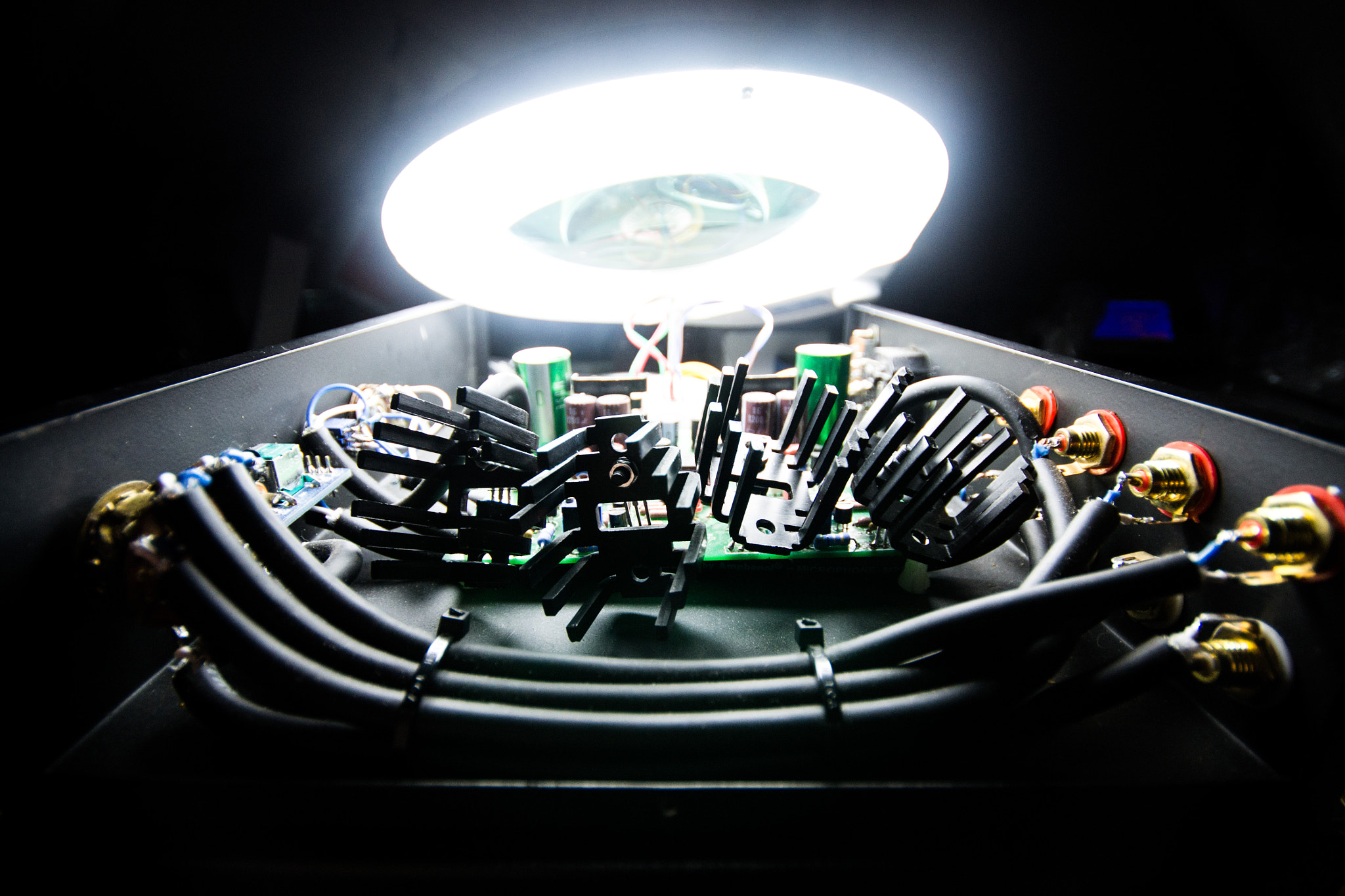
A discrete op-amp rejects the constraints of a single silicon chip. Instead of printing everything on micro-scale silicon, designers select individual, full-sized components—matched JFETs, bipolar transistors, precision metal film resistors, and high-quality capacitors—and arrange them on a small printed circuit board (often called a daughterboard) that plugs into the amplifier’s socket. Brands like Sparkos Labs, Burson Audio, and DEXA have popularized these modular discrete op-amps in high-end headphone gear.
Why Discrete Amplification Appeals to Audiophiles
- Custom Class-A Biasing: IC op-amps must limit their power consumption and heat generation to prevent melting the tiny plastic package. Discrete op-amps, having a much larger surface area, can run at high bias currents, keeping the input and gain stages operating in pure Class-A. This eliminates crossover distortion entirely and provides a smoother, more tube-like sound.
- No Silicon Compromises: Designers can use high-voltage, high-performance transistors (like JFETs from Linear Systems) that cannot be integrated into standard IC manufacturing processes. They can also use precision metal-film resistors with near-zero thermal noise.
- Higher Voltage Headroom: Many IC op-amps are limited to ±15V or ±18V power rails. Discrete op-amps can easily handle ±24V or even higher, which translates directly into higher dynamic range, greater voltage swing, and better handling of high-impedance headphones.
The Physical Limitations of Discrete Modules
The primary drawbacks of discrete op-amps are size, cost, and thermal stability. A single discrete op-amp module can be twenty times larger than an IC chip and cost upwards of $40 to $100. Additionally, because the transistors are physically separated, they do not track thermal changes as instantly as an IC, requiring careful thermal coupling (often using copper shields or thermal paste) to prevent drift.
Head-to-Head Comparison: The Audio Benchmarks
When making a purchasing decision, understanding the technical differences is key. On our HeadphonePalace Comparison Page, we analyze various hardware configurations. The table below outlines how these two technologies stack up against each other across critical operational metrics:
| Specification / Metric | Integrated Circuit (IC) Op-Amps | Discrete Op-Amps |
|---|---|---|
| Physical Size | Microscopic (DIP-8, SOIC-8) | Large (Modular Daughterboard) |
| Cost per Channel | Low ($1 – $10) | High ($30 – $100+) |
| Operating Voltage | Usually limited to ±15V to ±18V | Can exceed ±24V to ±30V |
| Biasing Mode | Typically Class-AB (low power) | Can run in pure Class-A |
| Component Quality | Silicon-printed compromises | High-grade individual transistors & resistors |
| Thermal Tracking | Near-perfect (shared silicon die) | Requires physical/mechanical coupling |
| Upgradability | Often soldered (unless socketed) | Designed for plug-and-play sockets |
The Verdict: Finding Your Sonic Purity
Ultimately, the choice between discrete and integrated circuits isn’t a simple matter of “better” or “worse.” It is a question of design philosophy.
Integrated circuits represent the triumph of modern engineering: near-perfect measurements, ultra-low cost, and micro-scale efficiency. They are the ideal choice for modern portable DAC/amps, active studio monitors, and transparent reference gear.
Discrete op-amps represent the artistic side of audio reproduction. By freeing the circuit from the physical confines of silicon, engineers can tune the performance, run the circuit in Class-A, and achieve a level of dynamics, space, and texture that measurements alone don’t always capture.
If you are searching for pure technical transparency, modern ICs are difficult to beat. But if you want to extract every ounce of texture, separation, and dynamic impact from your favorite headphones, a discrete op-amp amplifier might just be the upgrade you are looking for.
Discuss more about this, FAQ, Announcements and Miscellaneous, over on our community.
