In the high-fidelity audio universe, few technologies command the same level of reverence as electrostatic transducers. Unlike standard dynamic or planar magnetic headphones, electrostatics rely on the forces of attraction and repulsion between an ultra-thin, electrically charged membrane and two flanking metal plates. When Sennheiser released the legendary Orpheus (HE 90) system in 1991, they established a gold standard for what headphones could achieve—though at a staggering cost that made it a pipe dream for most. Realizing the desire for this unparalleled level of sonic clarity in a more approachable format, Sennheiser released the Sennheiser HE 60 (affectionately dubbed the “Baby Orpheus”) and its companion HEV 70 amplifier in December 1993.
The HE 60 system represented an ambitious effort to bring electrostatic perfection to a wider audience of audiophiles, offering a glimpse into the dizzying height of electrostatic engineering without the five-figure price tag of its larger sibling. Today, decades after its discontinuation, the Sennheiser HE 60 remains one of the most sought-after collector items in the world of high-end personal audio. For enthusiasts looking to dive deeper into the history of high-fidelity gear or discover modern reviews, the homepage of Headphone Palace serves as an invaluable resource.
The Genesis: Following in the Footsteps of the Giant
To fully appreciate the significance of the HE 60, one must first look at the state of personal audio in the early 1990s. The launch of the original Sennheiser Orpheus HE 90 in 1991, which was paired with the gorgeous, vacuum-tube-driven HEV 90 amplifier, shook the foundations of the industry. Limited to only 300 units worldwide and costing around $12,000 at release, the Orpheus was less of a commercial product and more of a statement of technological supremacy. It was Sennheiser showing the world that they could create the best headphones on Earth, bar none.
However, Sennheiser’s engineering team, led by brilliant acoustic minds, knew that the core technology developed for the HE 90 deserved to reach more ears. Thus, in late 1993, the HE 60 / HEV 70 system was introduced. Sold at a fraction of the Orpheus’s price, it was meant to compete directly with Stax, the Japanese electrostatic giant that had dominated the high-end electrostatic landscape for decades. Though built with more cost-effective materials, the “Baby Orpheus” shared the design ethos of the flagship model: an uncompromising commitment to acoustic transparency, blistering transient speed, and a highly linear frequency response.
The Physics of Electrostatic Mastery
What makes the Sennheiser HE 60 a “masterpiece” electrostatic? The answer lies in the physics of its driver. In a standard dynamic driver, a voice coil is glued to a cone-shaped diaphragm. The coil is heavy, and the physical connection creates structural resonances that lead to distortion. Electrostatic drivers, however, use a fundamentally different approach. The driver consists of an extremely thin, gold-vaporized polymer diaphragm suspended between two acoustically transparent metal grids called stators.
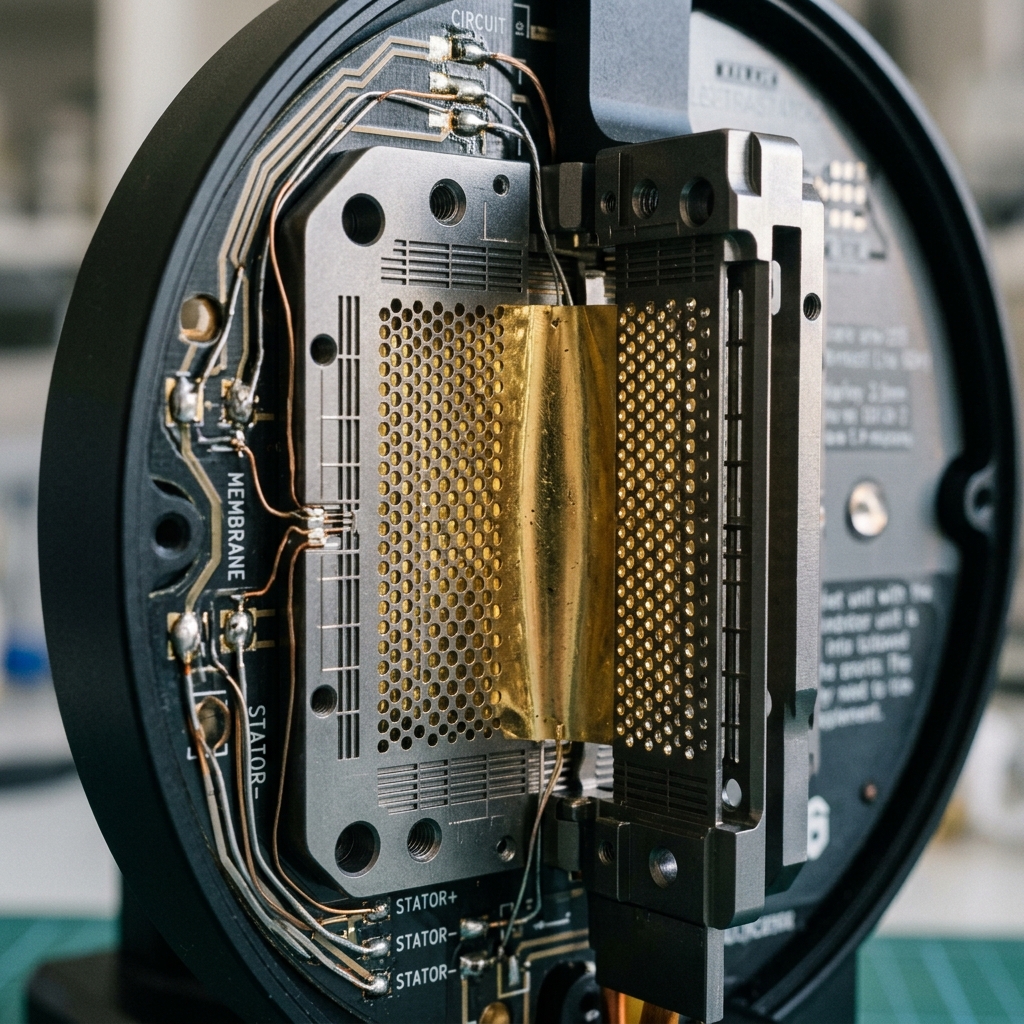
A constant, high-voltage DC bias (540V in the case of the HE 60) is applied to the diaphragm, charging it with a static electrical charge. When an audio signal is fed into the stators, it creates an alternating electrostatic field. This field pulls and pushes the uniformly charged diaphragm across its entire surface simultaneously. Because the diaphragm is incredibly light (often less than a micron thick, which is thinner than a red blood cell) and has no voice coil or physical points of contact other than its outer rim, it moves with near-zero inertia. This results in a frequency response that extends far beyond the human range of hearing—from 12 Hz up to a staggering 65,000 Hz.
The Technical and Aesthetic Compromises
While the original Orpheus was clad in premium wood, glass, and leather, the HE 60 had to meet a much tighter budget. Sennheiser decided to utilize a plastic-heavy chassis that borrowed heavily from the physical design of the Sennheiser HD 580 Precision, which was released around the same time. The HD 580 chassis would later evolve into the iconic HD 600 and HD 650, which explains why the HE 60 has a shape and headband mechanism that feels instantly familiar to modern audiophiles.
This chassis design choice had major pros and cons:
- Extreme Comfort: Weighing only 260 grams, the HE 60 is remarkably light for an electrostatic headphone. Combined with soft, breathable velour/pleather earpads and a simple suspension headband, it remains one of the most comfortable headphones ever made, causing no neck fatigue during multi-hour listening sessions.
- Fragility and Wear: The plastic construction, while light, was prone to cracking if handled roughly. More critically, the internal foam damping materials and the synthetic leather headband cushioning tend to disintegrate over time, turning to sticky black dust. Original units in the wild today almost always require replacement pads and headbands.
- Aesthetic Perception: To some buyers, paying a premium price for a headphone that looked like a HD 580 was a tough sell, especially compared to the heavy metal and wood construction of Stax Omega or Sennheiser’s own HE 90.
The HEV 70: A Controversial Partner
The HE 60 headphones were sold as a package with the Sennheiser HEV 70 energizer (amplifier). While the headphones themselves were universally praised, the HEV 70 quickly gained a reputation as the “weak link” of the system. Designed as a compact, solid-state amplifier, the HEV 70 was prone to running extremely hot, and its power supply was relatively modest. Audiophiles noted that the HEV 70 introduced a slightly harsh, analytical character to the treble and lacked the current capacity to drive the HE 60 to its full potential.
Because the HE 60 requires a 540V DC bias and uses a proprietary 6-pin connector, owners were originally locked into the HEV 70. However, the DIY audiophile community soon discovered that the HE 60 drivers could handle the standard 580V DC “Pro-Bias” used by Stax amplifiers. Today, many collectors choose to reterminate their HE 60 cables to a standard Stax 5-pin plug, or use custom-built adapters. Driving the HE 60 with a high-end Stax amplifier (such as the tube-based SRM-T1S or solid-state SRM-717) or a custom boutique amplifier (like the Blue Hawaii) reveals a whole new level of performance, particularly in terms of bass control, soundstage depth, and treble refinement.
Comparing the Titans of Electrostatics
To understand where the Baby Orpheus sits in the pantheon of electrostatic history, it is helpful to compare its specifications and design with the flagship HE 90 and its primary Stax competitor of the era. The table below outlines the core differences between these legendary systems:
| Specification | Sennheiser HE 60 (Baby Orpheus) | Sennheiser HE 90 (Orpheus flagship) | Stax SR-007 Omega II (Reference) |
|---|---|---|---|
| Transducer Type | Electrostatic (Push-Pull) | Electrostatic (Push-Pull) | Electrostatic (Push-Pull) |
| Frequency Response | 12 Hz – 65,000 Hz (-10 dB) | 7 Hz – 100,000 Hz (-10 dB) | 6 Hz – 41,000 Hz |
| Bias Voltage Required | 540 V DC | 500 V DC | 580 V DC (Pro-Bias) |
| Diaphragm Thickness | Approx. 1.0 micron (gold-vaporized) | Approx. 1.0 micron (gold-vaporized) | Approx. 1.3 micron |
| Weight (excl. cable) | ~260 g | ~365 g | ~365 g |
| Original Amp (Energizer) | Sennheiser HEV 70 (Solid-state/Hybrid) | Sennheiser HEV 90 (Tube) | Stax SRM-007t / SRM-717 |
| Market Status | Discontinued (Collector’s Item) | Discontinued (Ultra-rare Statement) | Discontinued (Collector’s Item) |
As the table demonstrates, the HE 60 offered an incredibly wide frequency response that rivaled the HE 90 flagship, despite having a much lighter driver housing and running at a slightly higher bias voltage. To explore more comparisons of vintage and modern electrostatic gear, check out the Headphones Category on Headphone Palace.
Visualizing the Frequency Extension Profile
The core advantage of the HE 60’s ultra-thin, low-mass diaphragm is its linear extension across the frequency spectrum. Unlike dynamic drivers that suffer from breakup modes and resonance roll-offs, the electrostatic driver delivers a flat response deep into the infrasonic and ultrasonic ranges. The graph below illustrates this difference conceptually, showing the difference in frequency extension and stability between the HE 60 and a typical high-end dynamic headphone:
The Sound Signature: Ethereal Midrange and Airy Treble
When driven by a high-quality amplifier, the sonic signature of the Sennheiser HE 60 is nothing short of magical. The standout feature is undoubtedly the midrange. Vocal performances, particularly female vocals, are rendered with a lifelike realism, breathiness, and emotional weight that very few modern headphones can match. There is an absolute lack of grain, and the spatial positioning of instruments within the soundstage is razor-sharp.
The treble is airy, sparkling, and infinitely detailed. Unlike many modern high-end headphones that boost the treble to create a false sense of detail, the HE 60 achieves its resolution through sheer speed. Cymbals ring out and decay with perfect naturalness, and room acoustics are laid bare. The bass is clean, articulate, and textured, though it does roll off in the lowest registers. Those accustomed to the heavy, physical bass slam of modern planar magnetic headphones might find the HE 60’s bass slightly polite, but in terms of speed and definition, it remains exemplary.
Preserving a Legend: Care and Maintenance
Owning a Sennheiser HE 60 in the modern era comes with a distinct set of responsibilities. Because these headphones have been out of production for over two decades and Sennheiser no longer stocks spare parts (particularly the drivers), they must be treated with extreme care. Electrostatic diaphragms operate by attracting charged particles, which means they are also natural dust magnets. A single speck of dust landing on the diaphragm can cause a static discharge, leading to channel imbalance, hums, or low squealing noises.
If you are lucky enough to own or acquire a Baby Orpheus, follow these guidelines to ensure its longevity:
- Dust-Free Storage: Always store the headphones in a dust-proof bag or case when not in use. Never leave them sitting exposed on a headphone stand.
- Control Humidity: Electrostatics are sensitive to moisture. Keep them in a temperature-controlled environment and avoid wearing them immediately after a shower or in high humidity.
- Gentle Cleaning: If the earpads or headband cushion need replacement, look for high-quality third-party velour options that match the dimensions of the HD 600 series, as original Sennheiser HE 60 pads are impossible to find.
- A Safe Power Source: Ensure your amplifier has a stable bias voltage. If using an adapter with a Stax amplifier, verify that the wiring is correct to avoid sending high-voltage spikes to the delicate drivers.
For more detailed preservation guides and deep-dives into legendary vintage gear, visit the Blog Category on Headphone Palace.
Conclusion: The Undying Appeal of the Baby Orpheus
The Sennheiser HE 60 “Baby Orpheus” remains an extraordinary milestone in audio history. It proved that the legendary sound of the Orpheus flagship could be distilled into a lightweight, comfortable chassis and made accessible to a broader audience. While the bundled HEV 70 amplifier held the headphones back, pairing the HE 60 with a modern electrostatic amplifier reveals a sonic performance that can still stand proud next to today’s best flagship headphones. It is a true masterpiece of electrostatic history—a testament to Sennheiser’s golden era of engineering and a collector’s dream that continues to enchant audiophiles around the world.
Discuss more about this, FAQ, Announcements and Miscellaneous, over on our community.
