Sound is more than just hearing—it is a visceral, emotional experience. When you listen to your favorite song, the texture of the singer’s voice, the resonance of the acoustic guitar, and the punch of the bass can transport you to another place. However, in our transition from physical media to digital convenience, a lot of that musical magic was sacrificed. For years, the MP3 format ruled the digital landscape, making music files small enough to stream over slow internet connections and store on devices with limited memory. But as storage space expanded and internet speeds soared, audiophiles and casual listeners alike began to ask: what did we lose in that compromise, and why does high-resolution (high-res) audio matter today?
At HeadphonePalace, we live and breathe high-fidelity audio. We believe that to truly appreciate the artistry of music, you need to understand the medium it is delivered in. Today, we are going to dive deep into the debate between lossy compression (represented by MP3) and lossless high-resolution audio (represented by FLAC). By the end of this comparison, you will understand exactly how audio formats affect what you hear and whether making the switch to high-res is worth your time and resources.
Understanding the Formats: What is MP3?
To understand why high-resolution audio matters, we must first look at the technology that dominated the last three decades of digital music: the MP3 (MPEG-1 Audio Layer III). Released in the early 1990s, MP3 was a breakthrough. At the time, storing uncompressed CD audio required about 10 megabytes (MB) of data per minute. On slow dial-up internet and early portable media players, this was prohibitively large. The MP3 solved this by shrinking audio files to about one-tenth of their original size.
How did it achieve this massive reduction? Through a process known as lossy compression. MP3 relies on psychoacoustics—the science of how humans perceive sound. Developers realized that the human brain cannot process every single frequency simultaneously. If a loud sound occurs, a quieter sound at a similar frequency is masked and becomes inaudible to us. MP3 algorithms intentionally strip away this “redundant” data, permanently discarding frequencies and dynamics that it assumes you will not miss. While this makes MP3 files incredibly portable and easy to stream, it removes the subtle layers, depth, and spatial cues that give music its three-dimensional feel.
Understanding the Formats: What is FLAC?
In contrast to the compromises of MP3, the Free Lossless Audio Codec (FLAC) represents the standard for digital preservation and audiophile-grade quality. Introduced in 2001, FLAC is an open-source, lossless audio format. This means that FLAC compresses the audio data, but it does so without throwing away any information. Think of it as a ZIP file for your music: when you play a FLAC file, it decompresses back into the exact digital replica of the original studio recording.
FLAC files are typically about half the size of uncompressed WAV files, yet they retain 100% of the original audio data. Because of this, FLAC is the format of choice for archiving music collections and for premium high-resolution streaming services like Tidal, Qobuz, and Apple Music (which uses its own lossless equivalent, ALAC). To explore more guides, equipment reviews, and technical deep-dives on audio gear, check out our dedicated audio blog. If you are interested in how different audio gear and formats compare in practice, feel free to explore our extensive audio comparisons.
Lossy vs. Lossless: Visualizing the Difference
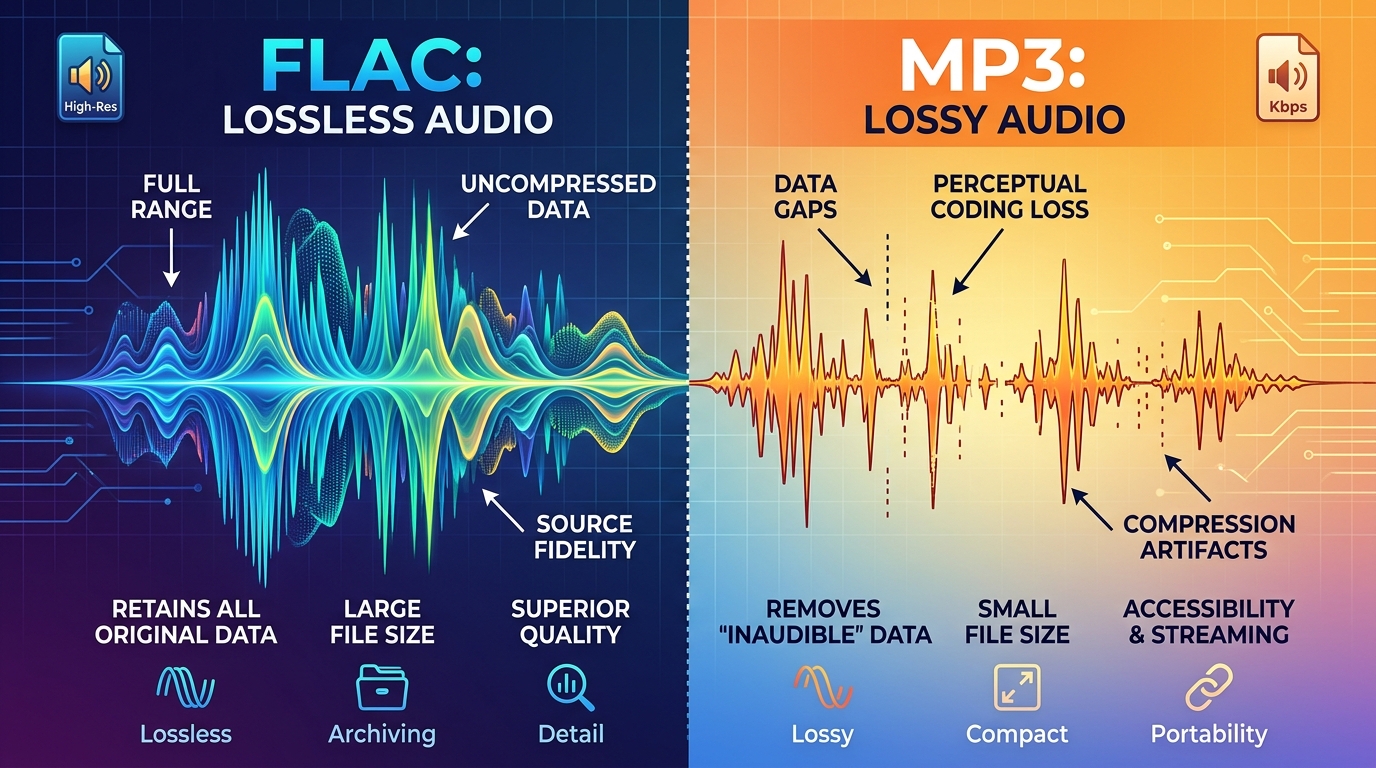
The differences between lossy MP3 compression and lossless FLAC quality are not just audible—they are visually measurable. The infographic below highlights how lossy compression shears off critical layers of sound waves, leaving gaps and introducing digital artifacts, while lossless compression preserves the entire dynamic waveform intact.
Why Does High-Res Audio Matter? The Science & Sensory Experience
When we talk about “High-Res Audio” (HRA), we are referring to audio files that surpass the quality of standard Compact Discs (CDs). CD quality is defined as 16-bit depth with a sample rate of 44.1 kHz. High-res audio, however, usually starts at 24-bit depth and sample rates of 96 kHz, 192 kHz, or even higher. But what do these numbers actually mean for your ears? Let’s break down the science:
- Bit Depth (Dynamic Range): Bit depth determines the dynamic range of a recording—the difference between the quietest and loudest sounds. 16-bit audio provides a dynamic range of 96 decibels (dB), which is more than enough for most listening environments. However, 24-bit audio increases this to a massive 144 dB. This extra headroom allows quiet passages (like a delicate piano key stroke or the fading decay of a cymbal) to be reproduced with extraordinary clarity and zero background noise.
- Sample Rate (Frequency Range): Sample rate refers to how many times per second the audio signal is captured during recording. A sample rate of 44.1 kHz can reproduce frequencies up to 22.05 kHz (comfortably above the human hearing limit of 20 kHz). A sample rate of 192 kHz captures data points at 192,000 times per second. While humans cannot hear frequencies above 20 kHz directly, the higher sample rate prevents filter distortion in the audible range, resulting in a smoother, more natural sound wave that closely mimics analog audio.
In terms of the sensory experience, high-res audio gives you a wider soundstage and better instrument separation. Instead of the music sounding like it is coming from a flat line between your ears, you can pinpoint where each instrument is positioned in the room. The attack and decay of notes feel more realistic, and vocals sound as if the singer is standing right in front of you. Over long listening sessions, high-res audio is also less fatiguing because your brain does not have to work to reconstruct the missing pieces of the audio puzzle, which is a common issue with heavily compressed MP3s.
The Bitrate Breakdown: Comparing Data Density
To put the difference into perspective, we can look at the bitrate, which is the amount of data processed per second. While a standard MP3 maxes out at 320 kbps (kilobits per second), CD-quality FLAC runs at 1,411 kbps, and a 24-bit/192kHz high-res FLAC file streams at a staggering 9,216 kbps. The SVG chart below illustrates this massive difference in data density, showing why FLAC can deliver so much more musical detail than an MP3.
Side-by-Side Comparison: FLAC vs. MP3
To help summarize the core differences between lossy MP3 and lossless FLAC formats, we have compiled a detailed breakdown of specifications, performance metrics, and use cases:
| Specification / Metric | MP3 (Lossy Format) | FLAC (CD Quality) | FLAC (High-Res Audio) |
|---|---|---|---|
| Compression Method | Lossy (discards audio data) | Lossless (perfect reconstruction) | Lossless (perfect reconstruction) |
| Bit Depth | Equivalent to < 16-bit | 16-bit | 24-bit |
| Sample Rate | Up to 48 kHz | 44.1 kHz | 96 kHz to 192 kHz (or higher) |
| Max Bitrate | 320 kbps | 1,411 kbps | Up to 9,216 kbps |
| Average File Size (4-min song) | ~3 to 10 MB | ~30 to 40 MB | ~100 to 200 MB |
| Compatibility | Universal (virtually all devices) | High (most modern devices/players) | Moderate (requires HRA compatible DAC) |
| Ideal Listening Scenario | Casual streaming on mobile data | Standard home listening & CD archiving | Critical listening on high-end audio gear |
Do You Need Special Gear to Hear the Difference?
Here is the hard truth about high-resolution audio: you cannot experience it with basic, cheap gear. If you are using budget plastic earbuds or the built-in speakers of your smartphone, you will not be able to tell the difference between a 128 kbps MP3 and a 9,216 kbps FLAC file. The small details are bottlenecked by cheap digital-to-analog converters (DACs) and low-cost speaker drivers.
To truly unlock the benefits of FLAC and high-res audio, your playback chain needs to support it. This includes:
- A Quality DAC (Digital-to-Analog Converter): Most laptops and phones have basic DACs that only support up to CD quality. An external USB DAC (like the AudioQuest DragonFly or a portable FiiO amplifier/DAC) will clean up electrical noise and decode 24-bit/192kHz signals cleanly.
- Hi-Res Headphones or Speakers: You need transducers that are capable of reproducing wide frequency ranges with low distortion. High-end open-back headphones or studio monitors are perfect for this. Explore our detailed reviews and guides in the headphones category to find the right gear for your listening setup.
- Wired Connection: Bluetooth compression algorithms (like SBC or AAC) compress audio, defeating the purpose of listening to lossless files. Even advanced Bluetooth codecs like Sony LDAC or aptX Adaptive compress high-res signals slightly to transmit them wirelessly. For pure, uncompromised lossless sound, a wired connection is always best.
Conclusion: Is High-Res Audio Worth It?
Does high-res audio matter? The answer is a definitive yes, but with a few caveats. If you are an avid music lover who appreciates the intricacies of production, instrument separation, and the warmth of a performance, upgrading to lossless FLAC and investing in quality playback gear is incredibly rewarding. It allows you to hear your favorite albums as the artist and engineer heard them in the recording studio.
Low-res streaming has its place, but for those special moments when you want to sit down and truly immerse yourself in the art of sound, high-res FLAC is the gold standard.
Discuss more about this, FAQ, Announcements and Miscellaneous, over on our community.
