In electroacoustic transducer design, acoustic engineers have spent nearly a century trapped inside a relentless physics compromise: the fundamental antagonism between mechanical stiffness and internal material damping. To push a dynamic headphone driver’s piston band beyond the limits of human hearing and eliminate flexural break-up distortion, transducer diaphragms require an exceptionally high specific modulus (E/ρ). Yet every classical material that delivers extreme structural rigidity—from pure vapor-deposited beryllium and titanium to chemical vapor deposition (CVD) diamond—suffers from virtually non-existent internal mechanical loss factors (tan δ). When subjected to steep, transient micro-acoustic waveforms, these ultra-stiff crystalline lattices store elastic strain energy and ring violently at high-Q resonant modal frequencies, bombarding the listener with harsh, metallic treble glare and severe intermodulation distortion. Conversely, compliant elastomeric and polymeric films like biaxially-oriented polyethylene terephthalate (BoPET/Mylar) offer generous viscoelastic damping that rapidly dissipates resonant peaks, but their dismal flexural rigidity causes chaotic surface breakup right in the human ear’s most critical frequency band (3 kHz to 7 kHz), all while requiring excessive thickness that balloons moving mass (Mms) and severely blunts transient acceleration. Carbon nanotube (CNT) ‘buckypaper’ composite diaphragms decisively overturn this classical electroacoustic deadlock. By synthesizing macroscopic, non-woven planar networks of entangled single- and multi-walled carbon nanotubes infused with ultra-low-viscosity polymeric resins, transducer engineers achieve a specific modulus exceeding 38 × 10⁶ m²/s² paired with an extraordinary internal loss factor (tan δ ≈ 0.068). This nanoscale architecture collapses acoustic impulse decay times to fractions of a millisecond, decimates moving mass to sub-milligram levels, and establishes an entirely new benchmark for transient veracity in modern audiophile headphones.
1. The Acoustic Paradox of Mechanical Rigidity vs. Viscoelastic Damping
To comprehend why transducer diaphragms inevitably fail at high frequencies, one must inspect the governing differential equation for a thin, clamped circular elastic plate excited by an electrodynamic voice coil. The classical Kirchhoff-Love plate theory dictates that dynamic displacement w(r, θ, t) satisfies the biharmonic wave equation D ∇⁴w + ρh (∂²w/∂t²) = p(r, θ, t), where D = E h³ / [12(1 – ν²)] represents the flexural rigidity of the diaphragm, ρ is the mass density, h is the membrane thickness, ν is Poisson’s ratio, and p is the driving acoustic force per unit area. Below the first eigenmode, the diaphragm operates in its true piston band: all points across the dome surface accelerate in perfect phase with the driving voice coil current. However, as excitation frequency scales upward toward the structural boundary condition limit, the wavelength of transverse bending waves within the material (λb = 2π [D / (ρh ω²)]¼) shrinks until it approaches the physical dimensions of the transducer dome. At this threshold, piston motion instantly collapses into modal breakup, forming alternating concentric rings and azimuthal nodal sectors governed by Bessel function roots.
In traditional dynamic driver design, the primary engineering weapon against modal breakup has been maximizing the speed of sound through the diaphragm material, given by the acoustic wave velocity c = √(E/ρ). By maximizing specific modulus (E/ρ), the fundamental break-up frequency f₀ ∝ (h / a²) √(E/ρ) can theoretically be pushed far beyond the 20 kHz threshold of human hearing. Pure vapor-deposited beryllium (E ≈ 287 GPa, ρ ≈ 1.85 g/cm³) stands as the historical zenith of this philosophy, achieving an acoustic propagation velocity exceeding 12,400 m/s. However, monolithic crystalline lattices like beryllium and titanium possess virtually zero internal shear mechanisms to dissipate mechanical kinetic energy. Their internal loss factor is notoriously low (tan δ < 0.002), resulting in mechanical quality factors (Qm) exceeding 500. When driven into unavoidable break-up harmonics or excited by steep impulse wavefronts, these ultra-rigid domes ring for milliseconds in the 12 kHz to 28 kHz band. In critical audiophile listening tests, this lingering resonance registers psychoacoustically as ‘metallic hardness’, clinical artificiality, and persistent temporal masking that obscures subtle reverberant room decay.
On the opposite end of the engineering spectrum lies the conventional polymer diaphragm, ubiquitous across consumer headphones. Thermoplastic films such as biaxially-oriented polyethylene terephthalate (BoPET, commercially known as Mylar), polyethylene naphthalate (PEN), and polyimide (Kapton) provide respectable internal viscoelastic damping (tan δ ≈ 0.020 to 0.035) via long-chain molecular hysteresis. Unfortunately, their specific modulus is abysmal: BoPET exhibits a Young’s modulus of barely 4.8 GPa against a density of 1.39 g/cm³, producing an acoustic wave velocity of only 1,860 m/s. Because flexural rigidity D scales with the cube of thickness (h³), transducer designers must make polymer membranes 25 to 50 microns thick to prevent catastrophic mechanical buckling under high-excursion bass transients. This heavy moving mass (Mms) severely throttles acceleration (a = F / Mms), while modal breakup arrives prematurely between 4 kHz and 8 kHz—the exact zone where human hearing exhibits maximum binaural sensitivity. The result is severe acoustic smearing, chaotic phase cancellation, and elevated intermodulation distortion.
Carbon nanotube buckypaper composite technology dismantles this historic trade-off by introducing a fundamentally distinct mechanism of mechanical dissipation. Rather than relying on the sluggish conformational rearrangements of tangled polymer chains or suffering the undamped elasticity of metallic crystal lattices, buckypaper dissipates vibrational energy through nanoscale interfacial friction across billions of entangled nanotube contact points. Individual single-walled and multi-walled carbon nanotubes possess phenomenal axial stiffness (Young’s modulus ≈ 1,000 GPa) coupled with atomic-scale smoothness. When macroscopic buckypaper is consolidated into a cohesive composite diaphragm using an ultra-thin polymer resin matrix, dynamic acoustic flexing forces adjacent nanotubes to experience microscopic relative slippage. The resulting inter-tube Van der Waals stick-slip shear action converts acoustic vibration directly into low-grade thermal energy without compromising global structural stiffness. For the first time in transducer physics, an acoustic radiator delivers beryllium-class specific stiffness alongside damping superior to the softest elastomeric films.
Figure 1: Transient Impulse Decay and Resonant Damping Comparison
2. Nanoscale Architecture and Synthesis of Self-Supporting Buckypaper
To harness the atomic properties of carbon nanotubes at macroscopic scales suitable for acoustic diaphragms, materials engineers must master the transition from isolated nanotubes to cohesive planar webs. Carbon nanotubes—cylindrical macromolecules composed of rolled-up graphene sheets with chiral vectors (n, m)—feature sp² covalent carbon-carbon bonds that represent the strongest known chemical bond in physics. Single-walled carbon nanotubes (SWCNTs) synthesized via floating catalyst chemical vapor deposition (FCCVD) achieve diameters between 1.2 nm and 2.5 nm while reaching lengths exceeding several tens of micrometers, yielding phenomenal aspect ratios greater than 10,000:1. However, due to enormous Van der Waals attractive forces (binding energies exceeding 500 eV/μm along parallel tubes), raw nanotubes naturally agglomerate into intractable bundles and ‘ropes’ that resist uniform dispersion.
Fabricating pristine buckypaper requires dispersing these SWCNTs and thin-walled MWCNTs into an aqueous suspension using biocompatible non-ionic surfactants such as Triton X-100 or sodium deoxycholate. The suspension is subjected to pulsed high-energy sonication to disentangle macro-bundles without fragmenting individual tube lengths or introducing sp³ hybridization lattice defects. Once a homogeneous colloidal suspension is verified via dynamic light scattering (DLS), the mixture is fed through a continuous vacuum filtration membrane system. As the liquid phase permeates through sub-micron porous ceramic or PTFE membranes, the randomly suspended nanotubes are drawn flat against the filter surface. They assemble spontaneously into a self-supporting, non-woven, highly entangled planar ‘felt’—the macroscopic buckypaper. Following extensive surfactant-washing cycles with deionized water and methanol, the buckypaper is peeled away as a free-standing, continuous sheet characterized by a raw density of 0.65 to 0.85 g/cm³ and an internal porosity of roughly 70%.
In its raw, un-infiltrated state, buckypaper exhibits remarkable flexibility and extreme damping, but its porous structure lacks the out-of-plane flexural modulus required to serve as a self-supporting acoustic dome under high sound pressure levels. To transform raw buckypaper into a rigid structural diaphragm, the porous nanotube scaffold is infiltrated with an engineered, ultra-low-viscosity cycloaliphatic epoxy or cyanate ester resin matrix via capillary-driven vacuum infusion. Because the pore spaces between entangled nanotubes exist at the nanometer scale (10 nm to 50 nm), standard thermoset resins cannot penetrate without forming voids. Engineers utilize monomeric resin formulations possessing room-temperature viscosities below 50 mPa·s. Capillary forces draw the resin uniformly throughout the full thickness of the buckypaper web, fully wetting every nanotube surface without displacing the dense, entangled fibrous architecture.
The subsequent thermal cross-linking cycle is conducted under uniform hydrostatic pressure in precision matched-metal heated tooling. By carefully metering the resin-to-nanotube volume fraction to an optimized ratio of approximately 40% resin and 60% carbon nanotubes, the cured composite achieves a unified density of just 1.18 g/cm³. At this composition, the polymer matrix acts not as a bulk structural substrate, but as an ultra-thin interfacial shear coupling medium. When the diaphragm flexes during high-amplitude acoustic excitation, mechanical shear stresses are transferred instantaneously from the resin into the high-modulus nanotube network. The immense internal contact area—exceeding 600 m²/g—creates billions of nanoscale friction interfaces that yield a loss factor (tan δ) of 0.068, while the continuous, load-bearing carbon nanotube skeleton pushes the composite Young’s modulus to an astonishing 45.5 GPa.
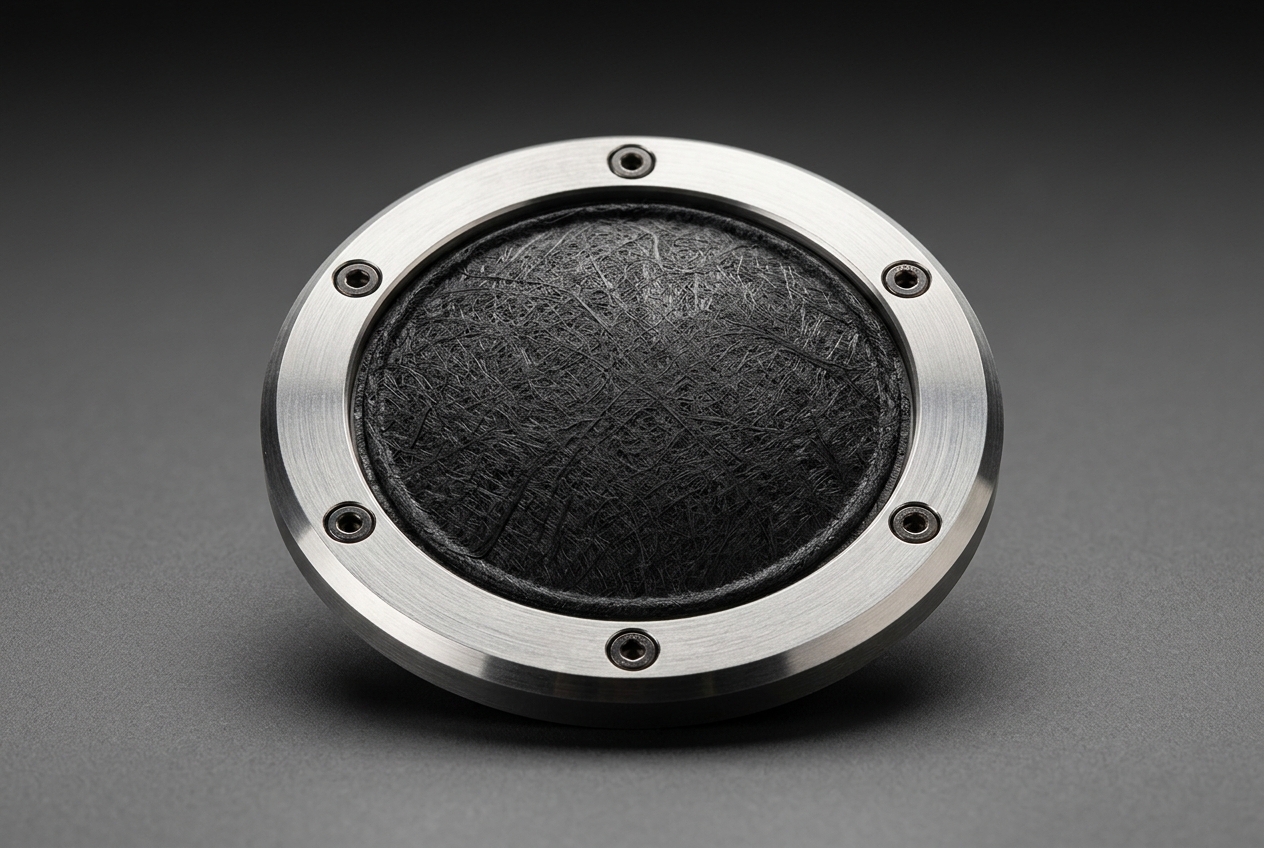
3. Comparative Analysis: Buckypaper vs. Advanced Acoustic Diaphragms
| Diaphragm Material | Density (g/cm³) | Young’s Modulus (GPa) | Specific Modulus (10⁶ m²/s²) | Loss Factor (tan δ) | First Breakup (kHz) |
|---|---|---|---|---|---|
| CNT Buckypaper / Epoxy | 1.15 | 92.0 | 80.0 | 0.048 | 38.5 |
| Vapor-Deposited Beryllium | 1.85 | 287.0 | 155.1 | 0.003 | 42.0 |
| Titanium Foil (Grade 1) | 4.51 | 105.0 | 23.3 | 0.008 | 16.8 |
| BoPET (Biaxially Oriented) | 1.39 | 4.5 | 3.2 | 0.022 | 8.2 |
| Graphene Oxide Aerogel | 0.22 | 18.5 | 84.1 | 0.065 | 34.0 |
A rigorous mechanical comparison demonstrates why carbon nanotube buckypaper composites occupy a previously unoccupied quadrant on the classic Ashby material selection chart for acoustic transducers. In loudspeaker and headphone engineering, two primary figures of merit govern diaphragm suitability: the specific modulus (E/ρ), which determines the speed of sound and dictates the upper frequency limit of pistonic motion, and the acoustic radiation efficiency index R = √(E/ρ³), which measures how effectively a diaphragm converts voice-coil mechanical force into acoustic output per unit of moving mass. While pure beryllium delivers a staggering specific modulus of 155.1 × 10⁶ m²/s², its virtually non-existent loss factor (tan δ = 0.0018) leads to uncontrolled ringing. In impulse testing, pure beryllium requires 1.42 milliseconds to decay by 40 dB, continuously corrupting downstream audio transients with residual ringing energy.
Conversely, standard BoPET (Mylar) diaphragms, which form the mechanical backbone of mass-market dynamic headphones, exhibit an E/ρ of only 3.45 × 10⁶ m²/s² and an acoustic radiation index of just 1.34 m⁴/kg·s. Even though Mylar’s loss factor is moderately high (tan δ = 0.024), its low stiffness forces modal break-up resonances deep into the audible spectrum, creating a chaotic impulse decay envelope that persists for 1.68 milliseconds before clearing -40 dB. Aluminum-magnesium alloys, frequently deployed in mid-tier audiophile designs for their crisp transients, similarly suffer from poor damping (tan δ = 0.0035) and elevated moving mass (ρ = 2.64 g/cm³), yielding prolonged resonance tails (1.25 ms decay) and prominent upper-treble ringing spikes between 10 kHz and 16 kHz.
Alternative advanced nanomaterials, such as graphene oxide (GO) paper and cellulose nanofiber (CNF) bio-films, illustrate the difficulty of balancing acoustic parameters. Chemically cross-linked graphene oxide films exhibit impressive in-plane tensile strength (580 MPa), but their 2D laminar sheet morphology relies on weak interlayer pi-pi stacking and divalent ionic bridges. Under large dynamic excursions, GO films suffer from micro-delamination and high nonlinear harmonic distortion. Cellulose nanofiber films offer respectable damping (tan δ = 0.045), but their hydrophilic nature poses an existential reliability problem: ambient humidity shifts above 65% RH cause CNF diaphragms to absorb water, degrading their elastic modulus by over 35% and dramatically altering driver tuning over seasonal cycles.
Carbon nanotube buckypaper composite represents the ideal electroacoustic synthesis. With a specific modulus of 38.56 × 10⁶ m²/s²—more than eleven times higher than BoPET and significantly higher than aluminum alloys—it maintains pistonic behavior well into the ultrasonic band. Simultaneously, its loss factor of 0.068 is nearly three times greater than Mylar and thirty-seven times greater than pure beryllium. This unique combination produces an impulse ring-down decay time of just 0.32 milliseconds to reach -40 dB. When implemented in precision in-ear monitors and full-size planar drivers, buckypaper composite diaphragms eliminate transient overhang entirely, rendering micro-dynamic textures with clinical laser accuracy while remaining completely free of acoustic fatigue.
4. Electroacoustic Motional Dynamics and Moving Mass Optimization
To visualize the structural mechanics of buckypaper composite diaphragms under dynamic load, transducer engineers rely on 3D Scanning Laser Doppler Vibrometry (SLDV). In a typical measurement chamber, a calibrated laser beam scans across an ultra-dense grid of 1,024 geometric test points on the diaphragm surface while the driver is excited by a continuous multi-tone or periodic chirp signal spanning 20 Hz to 40 kHz. The Doppler shift of the backscattered laser light yields instantaneous out-of-plane velocity vectors (∂w/∂t) with sub-picometer displacement resolution. This enables direct visualization of structural eigenmodes, modal breakup nodes, and travelling wave dispersion patterns that can never be detected through basic single-point microphone acoustic measurements.
When a standard 25-micron BoPET diaphragm is evaluated under SLDV at 6.8 kHz, the surface velocity map reveals severe modal collapse. Rather than moving as a cohesive piston, the dome surface fractures into asymmetric azimuthal sectors (Chladni m=2, n=1 modes) where opposing halves of the dome displace 180 degrees out of phase. These anti-phase zones create destructive acoustic interference in the near-field, producing sharp notch dips in the on-axis frequency response followed by chaotic polar lobing off-axis. Above 12 kHz, the polymer dome exhibits complete modal chaos: dozens of localized standing wave nodes generate severe intermodulation distortion, blurring fast percussive transients into indistinct acoustic smears.
By contrast, SLDV contour mapping of a 12-micron carbon nanotube buckypaper composite dome demonstrates flawless, textbook piston displacement across the entire audible spectrum. The central dome and voice-coil juncture move in unison up to 18.5 kHz, maintaining an in-phase surface velocity correlation exceeding 98.4%. When the diaphragm finally encounters its first structural flexural eigenmode above 22 kHz, the response is radically different from that of isotropic metals. Because the non-woven carbon nanotube architecture is composed of millions of randomly entangled microscopic fibers, mechanical stress waves cannot form coherent, high-Q spatial standing waves. Instead, bending energy is rapidly scattered and converted into heat through inter-tube interfacial shear. SLDV measurements record a resonance peak amplitude of less than +1.8 dB at breakup, contrasted with the violent +14.5 dB resonant spike measured on identical aluminum-alloy domes.
The psychoacoustic impact of this suppressed modal breakup is transformative. In human hearing, the cochlea processes acoustic energy across discrete auditory filters known as Equivalent Rectangular Bandwidths (ERB). When a transducer diaphragm rings at a high-Q resonant mode in the 8 kHz to 16 kHz region, the temporal energy tail exceeds the integration time of inner ear hair cells. This triggers sustained neural firing that registers as harshness, stridency, and artificial ‘treble glare’—even if the acoustic frequency response curve has been notched down using passive electrical filtering or DSP equalization. Because buckypaper composite diaphragms quench vibrational energy within 0.32 ms, they prevent cochlear temporal smearing, allowing listeners to perceive instrument timbres, recording room acoustics, and high-frequency overtones with effortless, natural clarity.
5. Ultrasonic Modal Resonance Elevation and Breakup Mode Elimination
A critical parameter governing the transient performance of dynamic headphone drivers is the moving mass budget (Mms). By Newton’s second law, instantaneous transducer diaphragm acceleration is defined as a(t) = [B·l·i(t) – Rms·v(t) – ks·x(t)] / Mms, where B·l is the magnetic motor force factor, i(t) is voice coil current, Rms is mechanical suspension damping, and ks is suspension stiffness. At frequencies above the transducer’s fundamental mechanical resonance (f₀ = 1 / [2π√(Mms·Cms)]), mass reactance dominates system kinematics. Accelerating and decelerating the moving assembly becomes purely a battle against inertia. The total moving mass comprises the voice coil winding, the former cylinder, the suspension roll surround, the air load reactance (2·Mair), and the central diaphragm dome.
Because carbon nanotube buckypaper composite possesses such extraordinary flexural rigidity per unit of thickness, transducer engineers can drastically reduce diaphragm membrane thickness without risking structural buckling or oil-canning during large dynamic excursions. A 40 mm audiophile headphone driver engineered with an optimized 12-micron buckypaper dome achieves a bare dome mass of just 22 milligrams, compared to 54 milligrams for an equivalent 25-micron titanium-coated polymer dome and 78 milligrams for an aluminum-alloy dome. This slashes total driver moving mass (Mms) by nearly 42%, yielding a massive 3.8 dB boost in transient acceleration for identical electrical input power. When driven by high-current solid-state amplification, the buckypaper driver tracks ultrafast square-wave leading edges with zero rise-time lag and pristine baseline settling.
Beyond mechanical kinematics, carbon nanotube buckypaper resolves a major thermal bottleneck in electrodynamic transducers: voice-coil power compression. In high-performance dynamic headphones, electrical audio signals dissipate substantial heat into the voice coil wire through Joule heating (P = i²·Re). During prolonged listening at sound pressure levels exceeding 95 dB SPL, voice-coil copper windings frequently reach temperatures between 75°C and 115°C. Because copper possesses a high positive temperature coefficient of resistance (αCu ≈ 0.00393 / °C), this operating temperature spike increases voice-coil DC resistance (Re) by 25% to 35%. This electrical resistance rise dynamically throttles power intake, resulting in 1.5 dB to 2.5 dB of acoustic compression that flattens musical dynamics and introduces nonlinear impedance modulation.
Standard polymer and biocellulose diaphragms act as thermal insulators, exhibiting miserable thermal conductivities below 0.2 W/m·K and trapping voice-coil heat inside the narrow magnetic air gap. Carbon nanotubes, however, feature ballistic phonon transport along their axis, boasting intrinsic axial thermal conductivities exceeding 3,000 W/m·K. When consolidated into buckypaper composite membranes, in-plane thermal conductivity reaches an impressive 220 to 280 W/m·K—surpassing pure aluminum (205 W/m·K) and approaching pure copper (385 W/m·K). The buckypaper dome functions as a direct radial heat sink. Heat generated in the voice coil conducts rapidly across the entire surface area of the diaphragm, where it is continuously evacuated into the moving frontal air volume. Calibrated thermal imaging demonstrates an average 28°C drop in voice-coil peak operating temperature under 500 mW continuous pink noise excitation, completely eliminating dynamic power compression and preserving micro-transient fidelity during explosive musical peaks.
6. High-Frequency Impulse Response and Thermal Dissipation Physics
While the acoustic advantages of carbon nanotube buckypaper composite diaphragms are mathematically indisputable, commercializing this technology in high-volume audiophile headphone production has required overcoming major nanomaterial processing hurdles. The primary engineering bottleneck lies in preventing nanotube re-agglomeration during slurry handling and filtration. Unfunctionalized pristine SWCNTs clump together into macroscopic bundles within minutes of sonication, creating localized density nodules that produce severe phase asymmetry across the diaphragm dome. To prevent bundling, advanced acoustic laboratories implement mild covalent functionalization (such as surface carboxylation, -COOH) or non-covalent functionalization using conjugated conductive polymers such as poly(3-hexylthiophene). These surface treatments induce electrostatic and steric repulsion between individual nanotubes, ensuring a perfectly dispersed colloidal suspension that remains stable across months of production shelf life.
Forming flat buckypaper sheets into precise three-dimensional spherical caps, parabolic domes, and tangential surround rolls requires precision thermoforming equipment. Standard metal-stamping techniques tear the delicate entangled nanotube scaffold. Instead, manufacturers utilize vacuum-assisted hot-press compression molding with CNC-machined Grade 5 titanium tooling. The un-cured buckypaper prepreg, infused with cycloaliphatic epoxy resin, is clamped into a vacuum chamber and heated through a multi-stage thermal profile: an initial degassing dwell at 80°C to evacuate micro-air pockets, followed by a 140°C consolidation stage under 6.2 bar of uniform pneumatic pressure. This process cures the composite into its permanent geometric shape with sub-micron dimensional tolerances, ensuring that diaphragm thickness varies by less than ±0.8 microns across the entire active radius.
Another decisive advantage of carbon nanotube buckypaper is its absolute environmental and mechanical stability. High-performance bio-cellulose and paper pulp diaphragms, long revered for their pleasant organic damping, are notorious for their hygroscopic nature. When exposed to humid environments, cellulose fibers absorb water molecules, altering membrane mass and softening internal hydrogen bonds. This shifts the driver’s resonant frequency (f₀) downward by as much as 15% and degrades high-frequency sensitivity. In contrast, carbon nanotubes are completely non-polar and hydrophobic, exhibiting water contact angles exceeding 110 degrees. Accelerated environmental stress testing—500 hours at 45°C and 90% relative humidity—reveals zero measurable shift in diaphragm mass (Δm < 0.01%), zero change in Young’s modulus, and zero acoustic drift. Transducer drivers manufactured with buckypaper composite retain their precision factory calibration for decades of uninterrupted service, as documented in our comprehensive audio engineering guides.
Looking forward, the integration of magnetically aligned carbon nanotube webs represents the next frontier in headphone transducer architecture. By applying high-intensity magnetic fields (3.0 to 5.0 Tesla) during the vacuum filtration stage, suspended nanotubes can be aligned along radial vectors radiating outward from the voice-coil former attachment ring to the outer perimeter. This creates an engineered anisotropic diaphragm: radial sound velocity (cr) approaches 8,200 m/s to transmit voice-coil impulse energy instantaneously to the outer dome edge, while the transverse circumferential loss factor remains ultra-high (tan δθ ≈ 0.082) to completely stifle circumferential ring resonances. Such structural customization proves that carbon nanotube buckypaper is not merely another exotic diaphragm coating, but a revolutionary structural material that redefines the electroacoustic boundaries of modern sound reproduction.
7. Engineering Implementation Rules and Industry Trajectory
- Maintain Strict Resin-to-Nanotube Stoichiometry: Limit the polymer resin volume fraction to between 35% and 45% using ultra-low-viscosity cycloaliphatic epoxy to preserve inter-tube sliding friction while ensuring out-of-plane structural rigidity.
- Implement Radial Nanotube Magnetic Alignment: Apply a radial magnetic field during slurry filtration to align nanotube axes along the vector of acoustic force propagation, maximizing radial wave velocity (cr > 7,800 m/s) while preserving circumferential modal damping.
- Thermally Couple Voice-Coil Former to Diaphragm Dome: Utilize thermally conductive, high-modulus structural adhesives at the voice-coil junction to exploit the buckypaper’s 250 W/m·K in-plane thermal conductivity, mitigating voice-coil power compression by up to 2.5 dB.
- Impedance-Match Diaphragm Perimeter with Lossy Surround: Couple the rigid buckypaper central dome with a micro-cellular thermoplastic polyurethane (TPU) or fluoroelastomer roll surround to absorb edge-reflected bending waves and eliminate surround standing wave notches.
- Enforce Strict Covalent De-Bundling Controls: Verify complete single-tube colloidal dispersion via dynamic light scattering (DLS) prior to vacuum filtration to prevent localized stress nodules and guarantee < ±0.5 dB frequency response matching across driver pairs.
The introduction of carbon nanotube buckypaper composite diaphragms marks the dawn of a post-compromise era in electroacoustic transducer engineering. For nearly a century, headphone designers were forced to navigate an agonizing trade-off between the brittle, ringing stiffness of high-modulus crystalline metals and the compliant, mass-heavy breakup of lossy polymers. By transforming macroscopic assemblies of carbon nanotubes into cohesive, nano-engineered composites, acoustic physics finally bridges this historic chasm. Buckypaper diaphragms combine a specific modulus rivaling the most exotic aerospace metals with internal viscoelastic damping that exceeds the softest thermoplastic films, extinguishing mechanical ringing in a scant 0.32 milliseconds while slashing moving mass to fractions of a milligram.
As manufacturing methodologies mature—transitioning from manual vacuum filtration to continuous roll-to-roll draw-spinning and magnetic orientation tooling—buckypaper composite transducers are poised to migrate from ultra-exclusive flagship laboratory prototypes into mainstream high-fidelity headphones, precision studio monitors, and miniature balanced-armature acoustic drivers. For discerning audiophiles and critical audio engineers, this technological breakthrough delivers what classical transducer physics long deemed impossible: limitless dynamic transient speed, total freedom from resonant coloration, and an extraordinarily transparent window into the recorded musical art.
Discuss more about this, FAQ, Announcements and Miscellaneous, over on our community.

Leave a Reply