When diving into the world of portable audio, you’ll quickly encounter two dominant types of earphones: In-Ear Monitors (IEMs) and Standard Earbuds. While they might look somewhat similar to the untrained eye, their design, fit, and audio performance are vastly different. In this comprehensive guide, we’ll break down the key differences between IEMs and standard earbuds to help you make an informed decision for your next audio upgrade.
What Are Standard Earbuds?
Standard earbuds, often just referred to as “earbuds,” are the most common type of earphones. They usually come bundled with smartphones and portable media players. They are designed to rest in the outer ear (concha) without entering the ear canal.
Because they don’t create a seal within the ear canal, standard earbuds allow ambient noise to enter. This can be beneficial for situational awareness—like when you are jogging or commuting in a busy city—but it detracts from audio fidelity and bass response. Earbuds rely on a single dynamic driver, which generally provides decent but unremarkable sound quality.
What Are In-Ear Monitors (IEMs)?
In-Ear Monitors, or IEMs, were originally developed for musicians and audio engineers to monitor live performances and studio mixes. Unlike standard earbuds, IEMs feature nozzles equipped with silicone or foam ear tips that are inserted directly into the ear canal. This creates a tight physical seal.
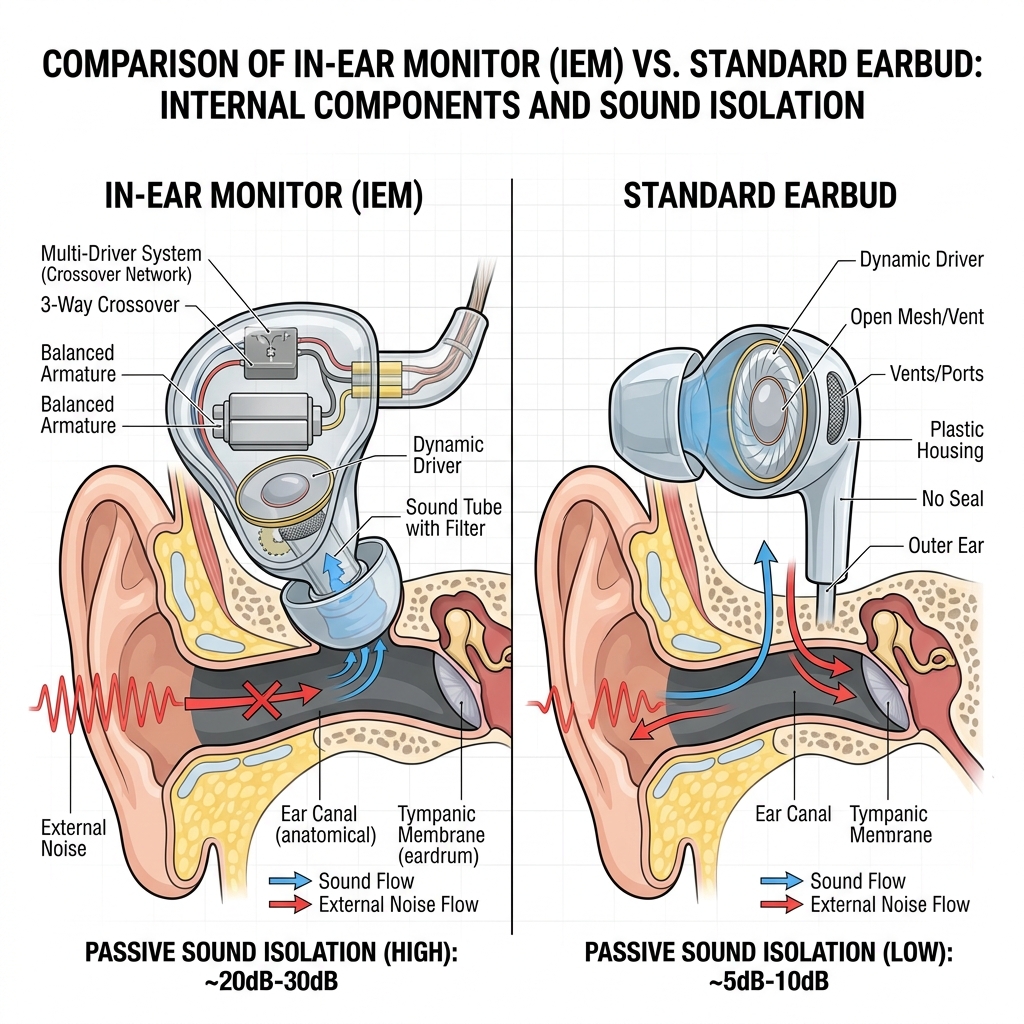
The seal created by IEMs provides passive noise isolation, blocking out a significant amount of external noise. This isolation allows you to hear the intricacies of your music at lower volumes, protecting your hearing over time. Furthermore, IEMs often utilize multiple drivers per earpiece (such as a combination of dynamic drivers and balanced armatures) separated by a crossover network, enabling them to reproduce sound with incredible detail, clarity, and separation.
Key Differences: IEMs vs. Earbuds
Let’s take a closer look at how these two audio formats stack up against one another in various categories.
| Feature | Standard Earbuds | In-Ear Monitors (IEMs) |
|---|---|---|
| Fit | Rests in the outer ear. | Inserts into the ear canal. |
| Noise Isolation | Poor; allows ambient noise. | Excellent passive noise isolation. |
| Sound Quality | Average; limited bass response. | High-fidelity; detailed, punchy bass. |
| Driver Setup | Usually single dynamic driver. | Often multiple drivers (Dynamic, BA, EST). |
| Cable | Typically fixed. | Often detachable and replaceable. |
| Price Range | Very affordable to moderate. | Moderate to very expensive (audiophile grade). |
1. Sound Quality and Isolation
The most significant difference lies in sound quality and isolation. IEMs dominate this category because their ear canal seal prevents bass frequencies from escaping. The ability to incorporate multiple drivers means an IEM can have a dedicated driver for bass, another for mids, and a third for treble, resulting in a cohesive and rich sound signature. Standard earbuds, due to their loose fit, struggle to deliver deep bass and detailed highs.
2. Comfort and Fit
Comfort is subjective. Some users find the intrusive nature of IEMs uncomfortable, especially for long listening sessions, though finding the right ear tip (silicone vs. foam, and proper size) usually resolves this. Earbuds are generally considered less intrusive, but they can easily fall out of the ear during physical activity since they lack a secure anchor.
3. Durability and Customization
Many modern IEMs, even budget models, feature detachable cables using 2-pin or MMCX connectors. This means if the cable breaks, you can simply replace it rather than buying a whole new pair of earphones. Standard earbuds mostly come with fixed cables, making them prone to being entirely discarded if the cable frays or a connection fails.
Which Should You Choose?
Your choice between IEMs and standard earbuds depends entirely on your use case and priorities:
- Choose Standard Earbuds if: You have a tight budget, dislike the feeling of things deep in your ear, need to hear your surroundings (like traffic when running), or just want a simple plug-and-play experience for casual listening and podcasts.
- Choose IEMs if: You care deeply about audio quality, want to block out background noise (like on airplanes or in loud offices), desire a secure fit for workouts, or want the longevity provided by detachable cables.
For most audio enthusiasts and casual listeners alike, the upgrade from a standard earbud to an affordable IEM is a revelation. The market has exploded with high-quality, budget-friendly IEMs that offer exceptional value, making high-fidelity sound more accessible than ever before.
Whether you’re mixing a track or just enjoying your favorite playlist on a commute, understanding the difference between IEMs and standard earbuds is the first step to curating your perfect audio experience.
Discuss more about this, FAQ, Announcements and Miscellaneous, over on our community.
