For more than half a century, stereo has been the undisputed king of music consumption. Since the transition from mono in the mid-20th century, two channels—left and right—have defined how artists record, engineers mix, and fans listen to music. However, a major technological shift is currently underway, redefining the sonic landscape. Dolby Atmos, an object-based spatial audio format originally designed for cinema, has rapidly transitioned into the music production world. If you want to keep pace with these groundbreaking changes in the audio industry, check out the HeadphonePalace homepage for the latest guides, reviews, and news.
What is Dolby Atmos in Music?
Unlike traditional channel-based audio formats (such as stereo or 5.1 surround sound), Dolby Atmos is an object-based audio technology. In a traditional stereo mix, sound is hard-coded to the left channel, the right channel, or somewhere in between using panning. If you want a sound to appear in the center, you feed equal signal to both channels.
In contrast, Dolby Atmos treats individual sounds—such as a vocal track, a guitar solo, or a synth sweep—as independent “audio objects.” Instead of assigning these objects to specific speaker channels, engineers place them in a virtual three-dimensional space using coordinate metadata (X, Y, and Z axes). During playback, the Dolby Atmos system dynamically renders the audio in real-time, tailoring the output to the listener’s specific speaker configuration. This could range from a full 11.1.8 recording studio setup to a pair of consumer headphones.
Key Terms to Know:
- Audio Objects: Individual audio tracks accompanied by 3D positioning metadata that can move dynamically through a three-dimensional space.
- Bed Channels: A traditional channel-based foundation (typically 7.1.2) used for background elements, reverbs, or low-end management that does not require dynamic movement.
- Binaural Rendering: The process of translating a 3D spatial mix into a standard two-channel headphone output using Head-Related Transfer Functions (HRTF) to simulate distance, height, and angle.
The Shift from Stereo to Spatial
The traditional stereo soundstage is linear, limited to a horizontal plane between two speakers. Music producers have spent decades using techniques like equalization, compression, and panning to create the illusion of depth and height within this narrow constraint. However, there is only so much acoustic real estate available in a stereo field before it becomes muddy and congested.
Dolby Atmos expands this canvas exponentially. By introducing a height dimension and a true surround field, mixing engineers can separate instruments more naturally. Vocals can sit perfectly in the center, while backing harmonies float slightly behind and above the listener. Drums can envelop the room, and sound effects can swirl around the listener’s head. This separation reduces the need for aggressive EQ and heavy compression, allowing instruments to retain their natural dynamics and timbre.
The Tech Behind Dolby Atmos Music
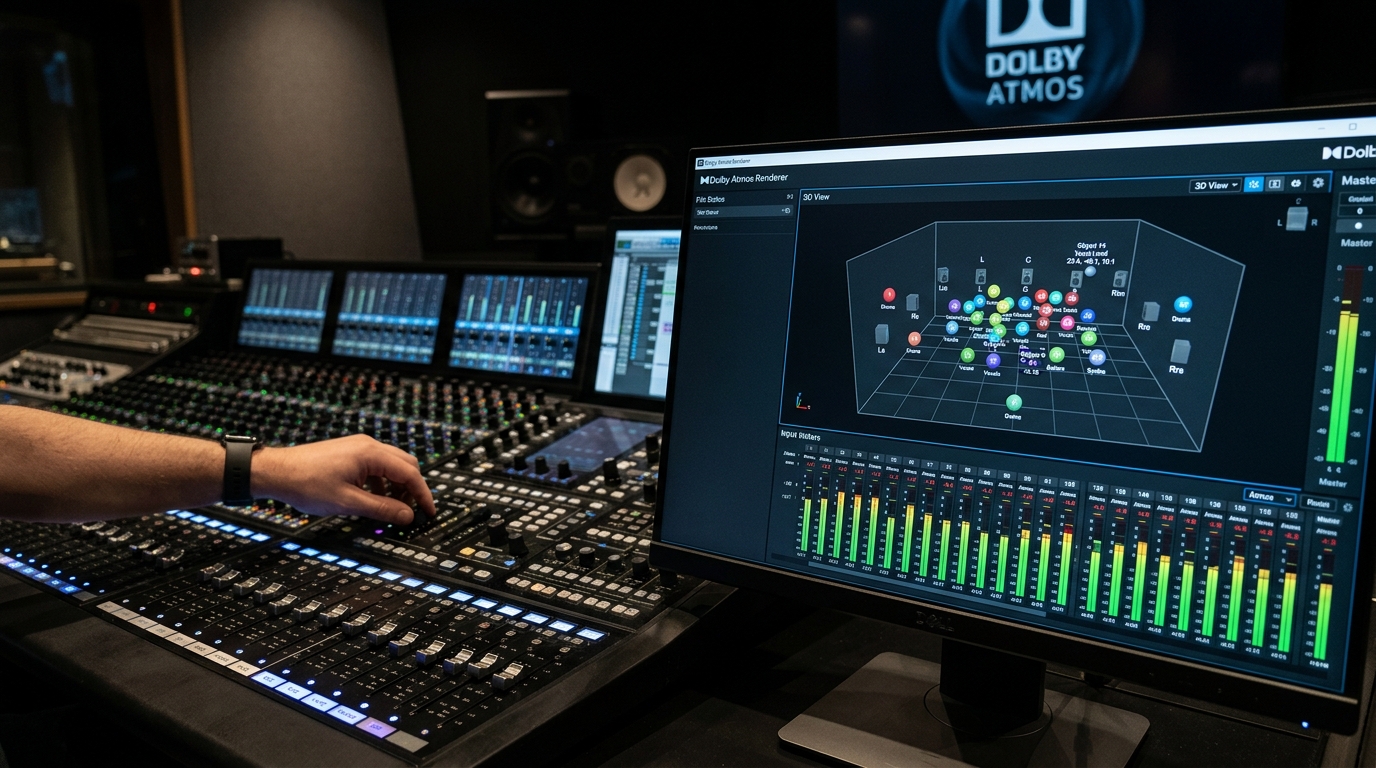
Behind the immersive experience is a complex framework that handles up to 128 simultaneous audio tracks. Out of these, 10 are typically reserved for the “bed” channels (7.1.2), leaving up to 118 tracks available for dynamic audio objects. When mixing, the engineer uses a specialized software application called the Dolby Atmos Renderer. This software communicates with the Digital Audio Workstation (DAW) to record the position, size, and movement of every object.
For everyday consumers, this technology is delivered through binaural audio. While professional studios mix with a physical array of dozens of speakers, most music lovers experience Dolby Atmos on headphones. Binaural technology simulates the way human ears receive sound waves from different directions in the real world. By applying subtle delays, frequency filters, and phase shifts, binaural rendering tricks the brain into perceiving sounds as coming from above, behind, or far to the sides. To understand how these formats perform on different consumer audio gear, explore our extensive headphones category for reviews and setup recommendations.
Adoption Across Streaming Platforms
The widespread adoption of Dolby Atmos would not have been possible without support from major music streaming platforms. When Apple Music announced in 2021 that it would offer Spatial Audio with Dolby Atmos to all subscribers at no extra cost, it acted as a massive catalyst for the industry. Other platforms quickly followed suit, making spatial audio accessible to hundreds of millions of listeners worldwide.
| Platform | Spatial Audio Support | Pricing Tier | Key Features |
|---|---|---|---|
| Apple Music | Yes (Dolby Atmos) | Standard Subscription | Automatic routing for AirPods, head tracking, curated spatial playlists. |
| Amazon Music Unlimited | Yes (Dolby Atmos / 360 Reality Audio) | Standard Subscription | Supports cast to Atmos-enabled smart speakers and soundbars. |
| Tidal HiFi Plus | Yes (Dolby Atmos) | HiFi / Premium Tier | High-fidelity spatial audio catalog with direct hardware pass-through. |
| Spotify | No | N/A | Does not currently support spatial audio formats. |
Dolby Atmos Adoption Trends (2020-2026)
The transition to spatial audio has accelerated dramatically over the past few years. Below is a visual representation of the growth in major studio releases mixed in Dolby Atmos, demonstrating its path to becoming an industry standard rather than a temporary trend.
How Music Producers are Adapting
The rapid rise of spatial audio has forced music producers and audio engineers to rethink their workflows and equipment. Historically, building a surround sound studio was an incredibly expensive endeavor, requiring specialized hardware controllers, massive mixing consoles, and precise acoustic treatment. Today, the barriers to entry are lowering.
1. DAW Integration
Almost all industry-standard DAWs now feature native Dolby Atmos integration. Avid Pro Tools, Apple Logic Pro, Steinberg Nuendo, and PreSonus Studio One all have built-in spatial panners and integration with the Dolby Atmos Renderer. This means that instead of routing signals through complex external interfaces, producers can mix in spatial audio directly within their favorite software.
2. Speaker Setup vs. Headphone Mixing
For commercial studios, upgrading to a physical Dolby Atmos setup is a significant investment. A standard Atmos setup for music requires at least a 7.1.4 configuration: seven ear-level speakers, one subwoofer, and four overhead height speakers. This setup must be meticulously calibrated for delay, volume, and frequency response to meet Dolby’s licensing standards.
Fortunately, engineers who do not have access to a full physical speaker array can mix using Dolby’s binaural rendering tools directly on headphones. While mixing entirely on headphones is not always ideal for establishing spatial accuracy, it provides an accessible entry point for indie producers and bedroom music creators.
Why Listeners and Artists Love Spatial Audio
The benefits of Dolby Atmos span across the entire chain of music creation and consumption:
- Creative Expression: Artists are no longer constrained by the stereo field. They can treat space as an instrument itself. A synthesizer can slowly spiral upwards, a vocal track can whisper directly into the listener’s ear, or the room acoustics of a concert hall can be accurately recreated.
- Acoustic Separation: Listeners can hear individual tracks with stunning clarity. In dense arrangements, such as orchestral scores or metal mixes, instruments do not clash or fight for space because they are separated across different spatial coordinates.
- Enhanced Realism: Live recordings mixed in Dolby Atmos recreate the actual venue acoustics, giving the listener the sensation of standing in the middle of the crowd or right on stage with the band.
For more detailed breakdowns on mixing techniques and review guides on spatial-enabled headphones, read our comprehensive audio blog, where we cover the latest developments in audio gear and software plugins.
Challenges and the Path Forward
Despite its rapid rise, the transition to Dolby Atmos is not without its share of hurdles. The primary challenge lies in quality control. Creating a great Atmos mix requires a different set of skills than stereo mixing. A poorly executed spatial mix can sound disjointed, with sounds panning erratically or vocals losing their impact and punch. This has led to some skepticism among traditionalists who view spatial audio as a temporary gimmick.
Additionally, because most consumers listen to Dolby Atmos via binaural rendering on headphones, the quality of the experience is highly dependent on the consumer’s headphones and the spatial translation algorithms used by their playback device. For instance, Apple’s personalized spatial audio uses head tracking and camera scans of the listener’s ears to customize the HRTF, but the results can still vary from person to person.
Conclusion: Is Dolby Atmos Here to Stay?
The rise of Dolby Atmos in music production marks a major leap forward in audio technology. Backed by industry giants like Apple, Universal Music Group, and Dolby Laboratories, spatial audio has quickly evolved from a niche audiophile curiosity into a mainstream standard. As consumer hardware becomes more advanced and mixing tools become more accessible, Dolby Atmos will continue to shape how we create and experience music for years to come. Whether you are a bedroom producer or a casual listener, spatial audio offers a fresh, immersive perspective on the music you love.
Discuss more about this, FAQ, Announcements and Miscellaneous, over on our community.
