If you have ever inserted a pair of high-end in-ear monitors (IEMs) into your ears, you might have felt a sudden, slightly uncomfortable sensation—a feeling of pressure buildup, akin to being in an airplane cabin during takeoff. For many, this “vacuum seal” is just a normal part of the audiophile experience. However, in recent years, manufacturers have increasingly introduced small holes or venting ports on the shells of their IEMs. What exactly do these tiny openings do, and how do they impact your listening experience? The short answer lies in dynamic pressure relief, a critical design choice that balances comfort, safety, and sound quality. To explore more about premium audio gear, visit the HeadphonePalace homepage, where we cover the latest advancements in audio technology.
The Physics of the Seal: Why Pressure Builds Up
To understand the necessity of venting ports, we must first look at how IEMs interact with your ear canal. Unlike traditional earbuds that sit loosely in the outer ear, IEMs are designed to insert directly into the canal, utilizing silicone or memory foam ear tips to create a tight, hermetic seal. This seal is crucial for two main reasons: it blocks external noise (passive noise isolation) and it traps air to ensure a robust bass response.
However, this tight seal turns your ear canal into a closed acoustic chamber. This leads to two distinct types of air pressure buildup that can negatively affect both your ears and your earphones:
- Static Pressure: This occurs during insertion. When you push the IEM into your ear canal, the ear tip acts like a piston in a syringe, compressing the air trapped between the tip and your eardrum (tympanic membrane). This static pressure pushes against your eardrum, causing discomfort, a stuffed-ear feeling, and temporary hearing sensitivity reduction.
- Dynamic Pressure: This happens during music playback. As the driver (especially dynamic drivers with a moving diaphragm) moves back and forth to create sound waves, it pushes and pulls the air inside the sealed chamber. Because the air has no way to escape, it resists the driver’s movement and exerts constant dynamic force on your eardrum.
What is an IEM Venting Port?
An IEM venting port is a miniature, engineered passage in the monitor’s shell that connects the acoustic chamber (either behind or in front of the driver) to the outside environment. These ports are far from random holes; they are precisely calculated micro-vents, often paired with acoustic filters or dampers, to regulate the flow of air. Check out our latest blog updates on HeadphonePalace to see how manufacturers are innovating in earphone ergonomics.
By letting air flow in and out of the ear canal, venting ports act as safety valves. When you insert the IEM, the excess static pressure is immediately equalized with the ambient room pressure. During playback, the dynamic pressure generated by the driver’s vibration is released, protecting your sensitive eardrum from constant physical stress.
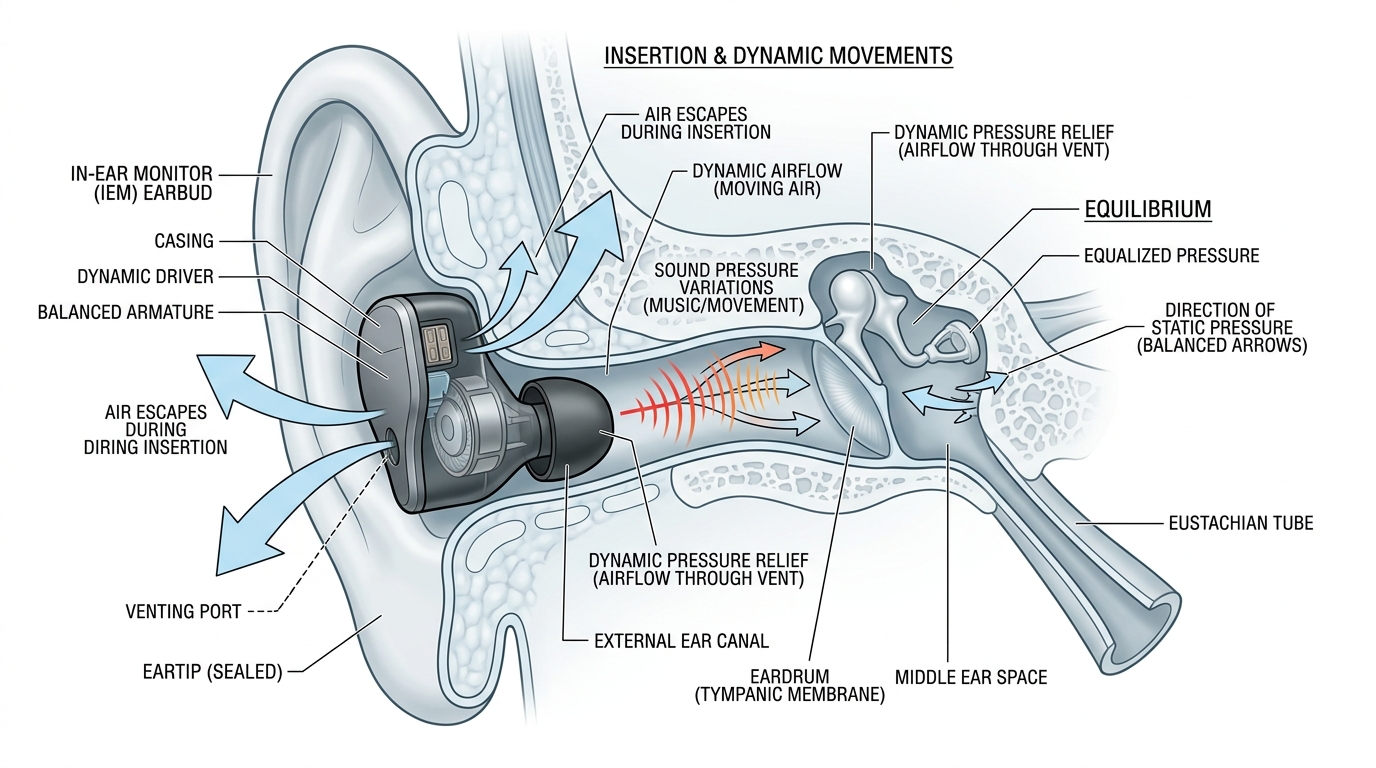
How Venting Ports Influence Sound Quality and Tuning
While comfort is a major driver behind vented designs, acoustic engineers also use venting ports as powerful tools to tune the sound signature of an IEM. The size, placement, and damping material inside a vent directly dictate how the IEM performs across the frequency spectrum.
1. Sub-Bass Control and Decay
In a fully sealed ear canal, bass frequencies can sound incredibly impactful, but they can also become bloated, boomy, or fatiguing. A venting port allows low-frequency sound pressure to escape in a controlled manner. By adjusting the vent’s acoustic resistance, manufacturers can shape the sub-bass rumble, speed up the decay of low notes, and create a punchier, cleaner bass response that doesn’t bleed into the midrange.
2. Expansion of Soundstage and Imaging
One of the primary complaints about fully sealed IEMs is that they sound “in-your-head.” The music feels like it is playing inside your skull rather than around you. Venting ports allow sound waves to disperse, mimicking the open, airy presentation of open-back headphones. This dramatically expands the perceived soundstage, giving instrument placement more air, separation, and realistic depth.
3. Prevention of “Driver Flex”
Have you ever heard an annoying plastic “clicking” or “crinkling” sound when inserting your dynamic driver IEMs? This is known as driver flex. It occurs when the trapped air pressure forces the driver’s thin diaphragm to bend or deform out of its natural shape. Vents prevent driver flex by ensuring that pressure equalizes instantaneously during insertion, safeguarding the lifespan of your dynamic drivers.
Visualizing Pressure Relief: Sealed vs. Vented
To better understand how venting ports mitigate pressure over time, look at the chart below. A sealed IEM maintains high pneumatic pressure inside the ear canal throughout insertion and playback, while a vented design equalizes the pressure within milliseconds of insertion.
Key Differences: Sealed vs. Vented IEMs
To help you choose between fully sealed monitors and those utilizing venting systems, we have compiled a comparison highlighting the primary trade-offs of each design. For side-by-side reviews, feel free to visit the HeadphonePalace Comparison Category.
| Feature | Sealed IEMs (Fully Closed) | Vented IEMs (Semi-Open / Pressure Relieved) |
|---|---|---|
| Static Pressure Buildup | High (causes “vacuum” sensation and ear fatigue) | None to Minimal (pressure equalizes instantly) |
| Noise Isolation | Excellent (maximum passive attenuation) | Moderate (some environmental noise leaks in) |
| Sub-Bass Quantity & Decay | Stronger, pressurized, slower decay | More natural, faster decay, cleaner rumble |
| Soundstage & Airiness | Narrow, “in-your-head” feeling | Wide, spacious, more open-back-like |
| Driver Flex Risk | High (diaphragm clicks on insertion) | Very Low (air escapes, preventing flex) |
| Long-Term Comfort | Can cause earache or fatigue after 1-2 hours | Highly comfortable for extended listening sessions |
Proprietary Dynamic Pressure Relieving Technologies
Several custom earphone manufacturers have developed complex, proprietary ventilation modules to optimize safety and sound quality. Two of the most famous examples are APEX and ADEL:
- 64 Audio APEX (Air Pressure Equalization): This technology uses an interchangeable module that fits into a vent hole on the IEM shell. The module contains a multi-directional membrane that vents air pressure while maintaining high isolation, giving the user a choice between different levels of bass response and isolation (e.g., -20dB, -15dB, or -10dB).
- Asius Technologies ADEL (Ambrose Diaphonic Ear Lens): This system uses a secondary elastomeric membrane (a tiny balloon-like structure) inside the earphone. The membrane absorbs the dynamic acoustic pressure instead of letting it strike the eardrum. ADEL claims this significantly reduces the risk of volume-induced hearing damage.
- Semi-Open Back Custom Shells: Brands like FiiO, Campfire Audio, and Unique Melody frequently release IEMs with large mesh grills or vents. These dynamic vents drastically widen the soundstage and provide unmatched dynamic driver breathing room.
Which One is Right for You?
Choosing the right pair depends heavily on your tolerance for pressure and your isolation needs. Explore our Headphones Category to find both vented and sealed options tailored to your preference.
If you primarily listen to music in noisy environments like subways, buses, or flights, a fully sealed IEM might be necessary to block out the noise. However, if comfort is your primary concern, or if you find yourself feeling fatigued after listening to ear canal monitors for an hour, looking for an IEM with dynamic pressure relieving venting ports is highly recommended. You will enjoy a much more open soundstage, natural bass reproduction, and long-term listening safety.
Discuss more about this, FAQ, Announcements and Miscellaneous, over on our community.
