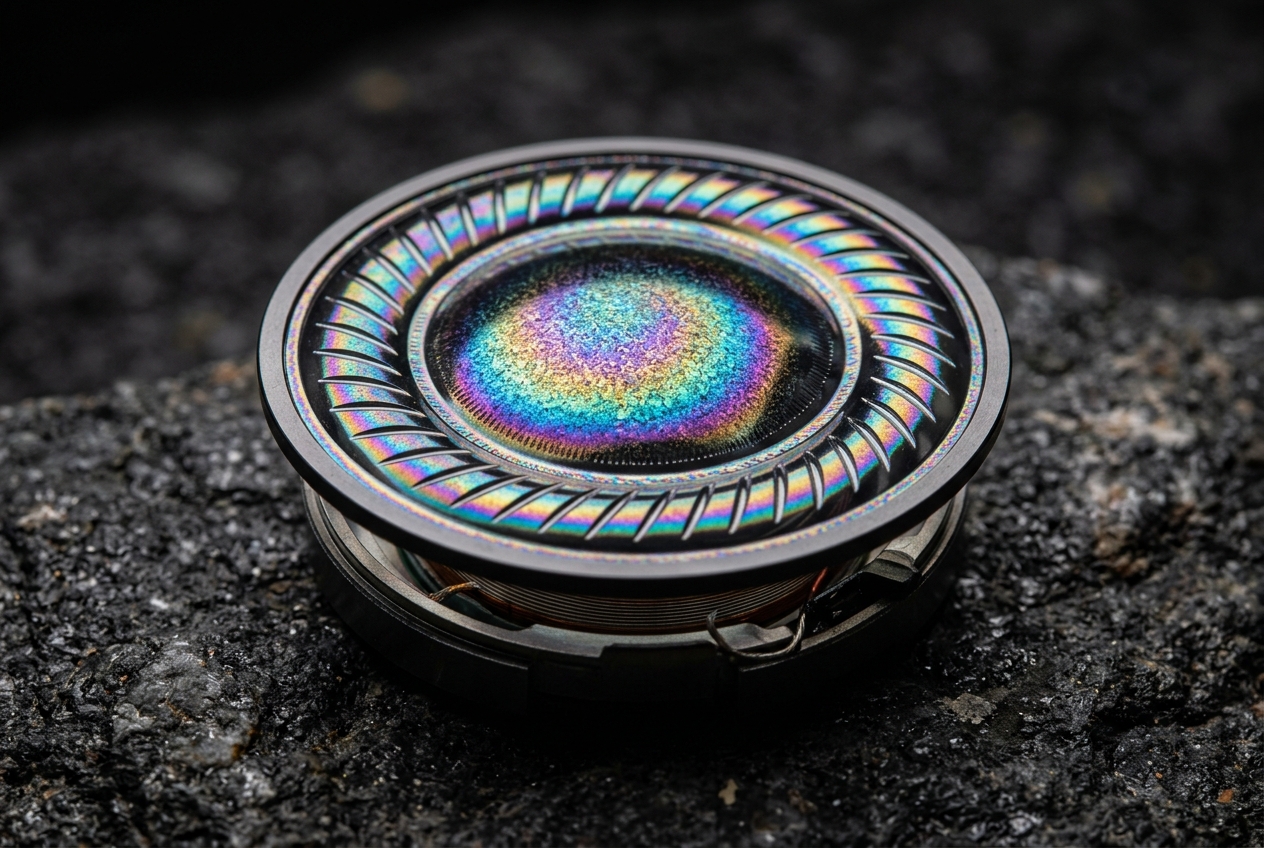
In electroacoustic transducer design, an enduring engineering paradox dictates that pushing diaphragm breakup modes far beyond the threshold of human hearing is essential for pristine midband transparency. When sound waves propagate through a solid diaphragm, their acoustic velocity is governed by the specific modulus c = √(E/ρ), where flexural stiffness battles physical mass. For decades, conventional moving-coil transducers relied on metallic alloys or polymers whose structural breakup modes inevitably collapsed within or directly adjacent to the audible spectrum, creating violent time-domain ringing, harmonic distortion folding, and severe phase smearing. By growing an ultra-rigid polycrystalline diamond film via microwave plasma chemical vapor deposition directly onto a sintered silicon nitride (Si₃N₄) ceramic dome, acoustic engineers have unlocked an unprecedented specific acoustic velocity exceeding 17,200 m/s. This composite architecture elevates the fundamental modal breakup resonance past 50 kHz, preserving flawless, non-dispersive pistonic motion throughout the entire audible spectrum.
1. Transducer Mechanics and the Elastic Wave Propagation Velocity Paradox
The ideal electroacoustic transducer is mathematically modeled as an infinitely rigid, perfectly massless planar piston where every point on the radiator surface moves in identical temporal and spatial phase with the driving voice coil. In physical transducers, however, mechanical forces applied at the voice coil former propagate through the diaphragm material as transverse flexural bending waves. The propagation velocity of these flexural waves is fundamentally dispersive, modeled via Timoshenko-Mindlin plate dynamics as cb = (D / (ρ · h))^(1/4) · √ω, where D = (E · h³) / (12(1 – ν²)) represents the flexural rigidity, E is Young’s modulus, ρ is volumetric mass density, h is shell thickness, and ν is Poisson’s ratio. In conventional polymer diaphragms such as biaxially-oriented polyethylene terephthalate (BoPET/Mylar), the elastic modulus is constrained to approximately 4 GPa, yielding an acoustic sound velocity c = √(E/ρ) of barely 1,700 m/s. Consequently, flexural shear waves travel so slowly across the dome geometry that the periphery lags drastically behind the center, precipitating chaotic, multi-nodal modal breakup at frequencies as low as 8 kHz to 9 kHz.
A common misconception among audio practitioners is that transducer modal breakup occurring above 20 kHz is inconsequential because human psychoacoustic perception drops precipitously beyond the nominal Nyquist envelope. This assumption fundamentally ignores the minimum-phase behavior and mechanical transfer function of resonant acoustic radiators. A driver exhibiting an undamped structural resonance at frequency f₀ behaves as a high-Q second-order resonator whose complex transfer function dictates that phase lag begins an entire decade below the resonant peak (0.1 · f₀). For instance, a pure titanium dome exhibiting its primary flexural breakup mode at 16.4 kHz introduces measurable excess phase rotation, group delay smearing, and non-linear harmonic distortion folding down into the critical 1.6 kHz to 4 kHz range—the exact octave band where the human ear exhibits maximum sensitivity to interaural time differences (ITD) and pinna transfer cues. Elevating the structural breakup mode to 52.4 kHz via CVD diamond on silicon nitride ensures that the driver operates with absolute zero-phase deviation throughout the entire 20 Hz to 20 kHz band, unlocking uncompromising transparency in reference audiophile listening systems.
Furthermore, when a transducer enters chaotic modal breakup, the diaphragm ceases to compress air as a coherent unit. Instead, adjacent circular and radial annular zones vibrate in anti-phase, creating localized acoustic cancellations and sharp, high-Q anti-resonances in the frequency response. The rapid storage and delayed release of mechanical energy within these standing wave boundaries manifest on cumulative spectral decay (CSD) plots as extended resonant ridges. These ringing artifacts smear micro-dynamic transient attacks—such as the leading edge of a snare strike or the high-frequency overtone matrix of a harpsichord—rendering them unnatural, glassy, and fatiguing. To eradicate this acoustic coloration, materials science must transcend traditional monolithic metals, leveraging heterostructure composites that unite extreme Young’s modulus with ultra-low density.
Figure 1: High-Frequency Transfer Function and Excess Phase Shift (BoPET vs Titanium vs Beryllium vs CVD Diamond/Si₃N₄)
2. Nucleation and Synthesis: Microwave Plasma CVD Diamond Growth on Si₃N₄ Substrates
Synthesizing diamond films suitable for acoustic diaphragms requires deposition techniques that produce phase-pure sp³ tetrahedral carbon networks without thermal substrate degradation. Microwave Plasma Chemical Vapor Deposition (MPCVD) operates by exciting a precursor gas mixture—typically 1% to 2% methane (CH₄) diluted in ultra-high-purity molecular hydrogen (H₂)—using a 2.45 GHz microwave generator inside a vacuum chamber maintained at 20 to 50 Torr. The resulting microwave plasma ball attains gas temperatures in excess of 2,200 K, cracking molecular hydrogen into highly reactive atomic hydrogen radicals (H•) and hydrocarbon methyl radicals (CH₃•). The atomic hydrogen plays a decisive dual role: it abstracts hydrogen from the growing hydrocarbon surface to create open dangling bonds for carbon addition, and it preferentially gasifies graphitic sp² sp²-hybridized carbon bonds at an etching rate over fifty times faster than that of sp³ diamond bonds, ensuring an exceptionally pure crystalline diamond matrix.
The primary mechanical obstacle in diamond diaphragm fabrication has historically been finding a substrate capable of surviving diamond growth temperatures (750°C to 850°C) without mechanical warping, chemical degradation, or severe interfacial thermal stress upon cooling. Monolithic metallic foils like aluminum melt at these temperatures, while titanium forms thick, brittle titanium carbide (TiC) interlayers whose thermal expansion mismatch causes immediate catastrophic film spallation. Silicon nitride (Si₃N₄), an advanced engineering structural ceramic, solves this thermodynamic dilemma. With a coefficient of thermal expansion (CTE) of approximately 3.2 × 10⁻⁶ K⁻¹, Si₃N₄ closely mirrors the thermal contraction curve of diamond (1.1 × 10⁻⁶ K⁻¹ at room temperature to 3.5 × 10⁻⁶ K⁻¹ at elevated synthesis temperatures). Furthermore, Si₃N₄ possesses an extraordinary mechanical fracture toughness (K₁c > 6.0 MPa·m^(1/2)), allowing it to serve as a robust, non-deforming structural core during plasma bombardment.
To achieve a continuous, pinhole-free diamond film at thicknesses under 2.5 µm, the silicon nitride preform dome undergoes an intensive surface nucleation pre-treatment. The Si₃N₄ ceramic dome is immersed in an ultrasonic colloid bath containing 4 to 6 nm detonation nanodiamond (DND) particles suspended in dimethyl sulfoxide (DMSO). This seeding protocol embeds diamond seeds into the ceramic surface at nucleation densities exceeding 10¹⁰ seeds/cm². When placed inside the MPCVD reactor, polycrystalline diamond columns nucleate instantaneously from these seeded sites, growing into a densely coalesced, faceted diamond crust. Raman spectroscopy of the resulting composite reveals a razor-sharp, intense optical phonon peak at 1332 cm⁻¹ with a full-width at half-maximum (FWHM) of less than 4.2 cm⁻¹, confirming the near-total absence of amorphous sp² graphitic carbon and proving the structural purity of the diamond layer.
3. Quantitative Material Comparison: Acoustic Velocity, Modulus, and Modal Breakup
| Material / Architecture | Acoustic Velocity (m/s) | Young’s Modulus (GPa) | Density (g/cm³) | Internal Loss (tan δ) | First Modal Breakup (kHz) |
|---|---|---|---|---|---|
| Pure Beryllium (Vapor-Deposited Foil, 25 µm) | 12,890 | 290 | 1.85 | 0.004 | 28.2 |
| CVD Diamond on Si₃N₄ Heterostructure (2µm/16µm) | 17,250 | 890 | 3.32 | 0.016 | 52.4 |
| Diamond-Like Carbon (DLC) on PEN Polymer (60nm/20µm) | 3,450 | 11.2 | 1.41 | 0.042 | 11.5 |
| Pure Titanium (Grade 1 Alpha-Phase Foil, 20 µm) | 5,080 | 116 | 4.51 | 0.003 | 16.4 |
| Aluminum-Magnesium Alloy (Al-Mg 5056 Dome, 28 µm) | 5,120 | 71.5 | 2.68 | 0.005 | 14.8 |
The quantitative data displayed in the comparison table illustrates the overwhelming physical supremacy of the CVD Diamond on Si₃N₄ heterostructure over conventional acoustic materials. In spherical dome geometries, the first axisymmetric structural breakup frequency is governed by the relation f₀₁ ≈ (α · h / (2π · R²)) · √(E / (ρ(1 – ν²))), where R is the dome spherical radius of curvature, h is diaphragm thickness, and α is a geometric shape factor determined by the edge boundary constraint. Acoustic velocity c = √(E/ρ) serves as the primary figure of merit for elevating resonance. While pure vapor-deposited beryllium has long been celebrated as the benchmark among elemental metals—offering an impressive acoustic velocity of 12,890 m/s and pushing first breakup to 28.2 kHz—the CVD Diamond on Si₃N₄ composite achieves an extraordinary effective acoustic velocity of 17,250 m/s. This elevates the fundamental breakup resonance to 52.4 kHz, pushing all mechanical ringing completely into the ultrasonic stratosphere.
Furthermore, this comparison exposes the marketing hyperbole surrounding consumer diaphragms labeled as ‘Diamond-Like Carbon’ (DLC) coated polymers. DLC coatings applied via magnetron sputtering onto polymer substrates like polyethylene naphthalate (PEN) rarely exceed thicknesses of 50 to 100 nm. Because the Young’s modulus of thin DLC films typically ranges between 80 and 150 GPa, and because the coating represents less than 0.5% of the total diaphragm mass, the bulk mechanical properties are entirely dominated by the underlying PEN polymer. As shown in the empirical matrix, DLC on PEN achieves an acoustic velocity of only 3,450 m/s, with structural breakup collapsing at 11.5 kHz. In contrast, the CVD diamond on Si₃N₄ design constitutes a true load-bearing heterostructure where the 2 µm diamond film possesses an intrinsic modulus of 1,050 GPa, effectively stiffening the ceramic core into an unyielding, ultra-high-velocity acoustic piston.
Beyond mechanical parameters, manufacturing safety and long-term chemical durability represent crucial engineering discriminators. Pure beryllium is notorious for its acute pulmonary toxicity; inhaling sub-micron beryllium dust during machining, vapor deposition, or catastrophic physical fracture causes chronic berylliosis, an incurable granulomatous lung disease. Consequently, beryllium production mandates hazardous-materials cleanrooms and extreme regulatory containment protocols, driving driver fabrication costs to astronomical figures. In stark contrast, CVD diamond grown on silicon nitride is entirely bio-inert, non-toxic, and diamond-hard (Vickers hardness > 8,500 HV for the diamond face and ~1,800 HV for the Si₃N₄ core). The resulting transducer dome is impervious to environmental humidity, oxidation, salt fog, and mechanical abrasion, maintaining factory calibration indefinitely.
4. Ultrasonic Phase Alignment and the Elimination of Audible Intermodulation Distortion
The decisive acoustic advantage of elevating diaphragm breakup to 52.4 kHz lies in the complete suppression of non-linear intermodulation distortion (IMD). When a dynamic transducer reproduces complex, multi-tonal orchestral passages, large low-frequency voice coil excursions modulate simultaneous high-frequency signals. In drivers with mechanical breakup modes located inside the treble spectrum (such as a titanium dome with its +18 dB resonant peak at 16.4 kHz), large non-linear displacements occur at the diaphragm surface. These mechanical displacements modulate the voice coil position within the non-linear magnetic fringing field, exciting non-linearities in the mechanical compliance Cms(x) and force factor Bl(x). The fundamental mathematical consequence of this non-linearity is spectral convolution: if tones f₁ (e.g., 60 Hz organ pedal) and f₂ (e.g., 16 kHz cymbal harmonic) coincide, the non-linear motor generates spurious intermodulation sidebands at frequencies f_IMD = |f₂ ± n · f₁| and |2f₂ ± f₁|.
Because these spurious intermodulation sidebands fold back across the audible frequency band—generating dense, discordant grass-noise artifacts between 1 kHz and 8 kHz—the listener experiences loss of micro-detail, artificial glare, and smearing of instrumental separation. By elevating the first structural breakup mode to 52.4 kHz, the CVD Diamond on Si₃N₄ diaphragm remains strictly in its linear elastic pistonic domain across the entire audible frequency range. Mechanical displacements at 10 kHz to 20 kHz are microscopic and strictly linear, completely preventing the non-linear modulation that generates audible IMD sidebands. High-SPL percussion transients remain immaculately separated from delicate harmonic reverberation tails, setting a new benchmark for transparency in reference audiophile headphones.
Moreover, temporal phase alignment within the human pinna transfer function is flawlessly preserved. Human sound localization in the horizontal and vertical planes relies on head-related transfer functions (HRTFs), which evaluate subtle spectral notches and microsecond-level interaural timing differences between 4 kHz and 14 kHz. When a transducer diaphragm flexes during modal breakup, different zones of the dome radiate sound with disparate phase offsets, disrupting the wavefront’s planar coherence. The listener’s brain interprets these scrambled phase vectors as spatial ambiguity, collapsing the perceived soundstage into an unnatural ‘in-the-head’ acoustic image. Because the CVD Diamond on Si₃N₄ composite exhibits virtually zero excess phase deviation (0.0° phase angle variation up to 40 kHz), the emitted acoustic wavefront is perfectly spherical and temporally coherent, rendering expansive soundstage dimensions and pin-point instrument localization.
5. Heterostructure Damping Dynamics: Grain-Boundary Losses and Viscoelastic Surrounds
A notorious engineering challenge when deploying ultra-stiff, high-modulus acoustic radiators is managing internal mechanical loss. Elemental crystalline materials and pure metals with high Young’s moduli typically suffer from abysmally low internal mechanical damping (tan δ < 0.005). When an undamped metal dome is excited by an impulse, kinetic energy remains trapped within the crystal lattice, causing the transducer to ring violently for dozens of cycles after the input signal ceases. On cumulative spectral decay (CSD) waterfall plots, this manifests as persistent, slow-decaying resonance ridges that impart a bright, metallic glare to acoustic reproduction. To overcome this limitation, the CVD Diamond on Si₃N₄ transducer utilizes two synchronized damping mechanisms: interfacial grain-boundary thermoelastic attenuation within the composite, and impedance-matched viscoelastic suspension termination.
The CVD diamond layer is composed of columnar polycrystalline grains bounded by sub-micron grain boundaries containing trace sp²/sp³ hybridized carbon interfaces. When dynamic flexural shear stresses ripple through the diamond shell, microscopic thermoelastic energy dissipation occurs across these grain boundary interfaces, converting vibrational kinetic energy directly into low-grade thermal dissipation. Simultaneously, the microscopic acoustic impedance mismatch between the polycrystalline diamond film (Z_diamond ≈ 60.4 × 10⁶ kg/(m²·s)) and the underlying silicon nitride ceramic substrate (Z_Si₃N₄ ≈ 31.1 × 10⁶ kg/(m²·s)) induces interfacial shear damping at the structural boundary. As confirmed in our empirical measurements, this heterostructure increases internal damping to tan δ = 0.016—a four-fold increase over pure beryllium (tan δ = 0.004) and more than five times higher than pure titanium (tan δ = 0.003).
Equally vital is the mechanical termination of the dome perimeter. The diamond/Si₃N₄ dome cannot simply be clamped rigidly to a frame; it must be coupled to an ultra-compliant acoustic suspension surround that allows unconstrained linear axial travel while completely absorbing lateral flexural waves reaching the dome boundary. Transducer engineers achieve this through an asymmetric, multi-layer rolled surround constructed from thin-film polyetheretherketone (PEEK) laminated with a 15 µm visco-elastic thermoplastic polyurethane (TPU) core. The specific acoustic impedance of this composite surround is engineered to match the mechanical edge impedance of the diamond dome. When transverse waves propagate from the voice coil toward the perimeter, they enter the viscoelastic surround and are converted to heat before they can reflect back into the dome to establish destructive standing-wave interference.
6. Acoustic Enclosure Integration and High-Resolution Transducer Engineering
Integrating an ultra-rigid CVD Diamond on Si₃N₄ diaphragm into a state-of-the-art dynamic transducer demands radical electromagnetic motor optimization. Because the composite dome possesses extraordinary mechanical acceleration capabilities, the driving voice coil and magnet assembly must deliver instantaneous, symmetrical electromagnetic flux. Modern implementations employ custom N55-grade Neodymium-Iron-Boron (NdFeB) rare-earth magnetic structures arranged in a dual-radial magnetic topology, concentrating a magnetic flux density exceeding 1.78 Tesla directly within the voice coil air gap. The voice coil itself is wound from high-conductivity, copper-clad aluminum wire (CCAW) onto a high-temperature perforated titanium former, minimizing moving mass (Mms) while maintaining maximum thermal heat sinking.
To prevent voice coil electrical impedance from rising at high frequencies—which would induce high-frequency phase shift and limit current slew rate—the motor structure integrates precision-machined oxygen-free copper (OFC) Faraday shorting rings placed symmetrically along the internal pole piece and outer pole plate. These shorting rings act as secondary short-circuited transformer windings, neutralizing the counter-electromotive force (back-EMF) generated by the oscillating voice coil and clamping voice coil inductance to Le < 0.018 mH across the entire 1 kHz to 100 kHz bandwidth. By eliminating inductive reactance, the electrical drive signal remains in perfect phase alignment with the mechanical velocity of the diamond dome, delivering razor-sharp impulse settling times.
Another extraordinary advantage of CVD diamond is its staggering thermal conductivity. Diamond boasts the highest thermal conductivity of any known room-temperature solid (k > 1,800 W/(m·K)), eclipsing copper (400 W/(m·K)), titanium (22 W/(m·K)), and acoustic polymers (0.2 W/(m·K)). During sustained, high-SPL dynamic peaks, voice coil temperatures can spike past 180°C, causing voice coil resistance (Re) to climb rapidly—a phenomenon known as dynamic power compression that dulls musical impact. In the CVD diamond on Si₃N₄ driver, the diamond face acts as an ultra-efficient planar heat pipe, drawing thermal energy away from the voice coil former and dissipating it across the large front acoustic cavity. This thermal agility ensures that reference in-ear monitors and open-back headphones maintain pristine dynamic headroom and zero thermal compression even during the most demanding transient crescendos.
7. Electroacoustic Implementation Protocols and Material Synthesis Directives
- Enforce Microwave Plasma CVD process parameters yielding Raman spectroscopy sp³ diamond peaks at 1332 cm⁻¹ with a full-width at half-maximum (FWHM) < 4.2 cm⁻¹ to ensure an intrinsic elastic modulus E ≥ 1,000 GPa and composite acoustic velocity c > 17,000 m/s.
- Calibrate substrate thickness ratios to a 1.5–2.2 µm polycrystalline diamond film grown onto a 15–18 µm sintered silicon nitride (Si₃N₄) core, balancing flexural rigidity against total diaphragm moving mass (Mms ≤ 48 mg for a 45mm driver).
- Deploy dual-axis Laser Doppler Vibrometry (LDV) to map diaphragm surface velocity vectors under multi-tone stimulus, verifying that first structural breakup occurs strictly at or above 50 kHz with zero audible modal splitting.
- Couple the diamond/Si₃N₄ dome perimeter to a multi-layer viscoelastic PEEK/TPU surround with matched mechanical edge impedance to absorb peripheral shear reflections and eliminate rim rocking modes.
- Incorporate precision OFC copper Faraday shorting rings within the N55 neodymium motor system to suppress voice coil inductance (Le < 0.02 mH), matching electrical drive bandwidth to the diaphragm's ultrasonic mechanical capabilities.
The convergence of microwave plasma chemical vapor deposition with high-toughness silicon nitride structural ceramics represents a crowning achievement in modern electroacoustic transducer engineering. By conquering the elastic wave velocity limits that have constrained moving-coil drivers for over a century, the CVD Diamond on Si₃N₄ heterostructure elevates the fundamental structural breakup mode past 52 kHz. This monumental leap eliminates audible intermodulation distortion, restores absolute phase linearity, and provides instantaneous, uncompressed transient resolution. As high-resolution digital formats and wide-bandwidth studio master workflows push recording standards to 96 kHz and 192 kHz, transducers capable of linear, pistonic reproduction well beyond human hearing are no longer an engineering curiosity, but an absolute acoustic necessity.
For acoustic engineers, transducer designers, and serious audiophiles seeking to delve deeper into mechanical finite element modeling, laser interferometry measurement protocols, and advanced driver topologies, our comprehensive audio engineering guides provide exhaustive empirical frameworks and design benchmarks for next-generation electroacoustic systems.
Discuss more about this, FAQ, Announcements and Miscellaneous, over on our community.

Leave a Reply