Dynamic moving-coil transducers have long harbored an insidious electroacoustic paradox: while transducer engineers obsess over micro-precise mechanical suspensions and ultra-rigid diaphragm geometries, the primary instigator of second-harmonic distortion (HD2) and dynamic DC drift in high-fidelity headphones stems not from the polymer surround, but from intrinsic motor asymmetry. In any classical single-gap electromagnetic motor, the instantaneous force factor Bl(x) traces a fundamentally skewed, non-symmetric trajectory as the voice coil traverses forward and backward through the magnetic fringe field. Because the magnetic circuit’s top plate interfaces abruptly with ambient air while the lower core pole terminates into a dense ferromagnetic back plate, the voice coil encounters a radically unequal magnetic flux gradient on inward versus outward strokes. This physical asymmetry mathematically births even-order non-linearities, polluting pristine fundamental low frequencies with unwanted second-harmonic distortion products and exerting an excursion-dependent DC rectification force that dynamically yanks the diaphragm away from its mechanical zero-point. To overcome this century-old limitation, state-of-the-art transducer designers have engineered dual-gap symmetrical voice coil architectures—an elegant electrodynamic breakthrough that uses opposed magnetic air gaps and push-pull split-coil geometries to physically cancel even-order motor asymmetry at the acoustic source.
1. The Electrodynamic Asymmetry Paradox: Unmasking Bl(x) Non-Linearity in Dynamic Drivers
In elementary electroacoustic theory, the mechanical Lorentz force driving a headphone diaphragm is treated as a simple scalar equation: F = B · l · i, where B represents the uniform magnetic flux density across the air gap, l is the total active conductor length, and i is the driving AC voice coil current. In practical, large-signal operating regimes, however, this scalar assumption collapses into a complex, displacement-dependent vector field. As low-frequency transients demand voice coil excursions approaching or exceeding the height of the magnetic gap, the effective force factor Bl becomes an explicit function of axial displacement x, denoted as Bl(x). In high-performance audiophile headphones designed for wide dynamic range and extended sub-bass reproduction, excursion peaks can routinely exceed ±1.5 mm to ±2.5 mm. Under these large-signal conditions, the non-linear behavior of Bl(x) dominates the total harmonic profile of the acoustic transducer.
To rigorously quantify this non-linear behavior, electroacousticians employ a polynomial Taylor series expansion centered at the mechanical rest position (x = 0): Bl(x) = Bl_0 + b_1 x + b_2 x^2 + b_3 x^3 + b_4 x^4 + …, where Bl_0 is the static small-signal force factor, and the coefficients b_n correspond to the n-th spatial derivatives evaluated at rest. The fundamental engineering problem in all conventional single-gap dynamic drivers is that the boundary conditions of the magnetic circuit are intrinsically asymmetric. The top plate of the motor assembly borders open air or a plastic driver chassis, where the relative magnetic permeability drops instantaneously to air (μ_r ≈ 1.0). Conversely, the lower boundary of the voice coil gap interfaces with the solid iron pole piece and steel back plate, where magnetic permeability remains high (μ_r > 2000). Consequently, the fringe magnetic flux lines bulge downwards toward the high-permeability steel, producing an elongated, gentle flux decay below the gap and an abrupt, razor-sharp flux cliff above it.
This structural boundary imbalance guarantees that the first spatial derivative b_1 = dBl/dx does not equal zero. The apex of the Bl(x) curve is mechanically offset from the driver’s rest center, typically resting shifted inward between x = -0.25 mm and x = -0.50 mm. When a symmetrical sinusoidal current i(t) = I_0 sin(ωt) excites the voice coil, the resulting mechanical driving force F(t) = Bl(x) · i(t) generates unequal force amplitudes on opposing half-cycles. On positive excursions (+x, pushing outward toward the listener’s ear), the coil rapidly sheds magnetic flux, experiencing an aggressive loss of Lorentz force. On negative excursions (-x, pulling inward toward the magnet), the coil stays enveloped in the iron-supported fringe field. This unequal force generation directly generates heavy second-harmonic distortion (HD2) and produces a non-zero time-averaged net force
Figure 1: Finite Element Analysis of Motor Non-Linearity — Single-Gap Asymmetry vs. Dual-Gap Push-Pull Symmetry
2. Physics of Even-Order Harmonic Generation: Reluctance Forces and Flux Modulation
The mathematical link between motor asymmetry and acoustic distortion is governed by nonlinear differential equations of motion. When the spatial derivative b_1 is non-zero, the electrodynamic motor acts as a mathematical square-law generator. Solving the dynamic equation of motion m_ms x”(t) + R_ms x'(t) + k_ms x(t) = Bl(x) · i(t) reveals that the second-harmonic sound pressure output p_2(t) scales directly in proportion to the product of b_1, the square of the driving current I_0^2, and the mechanical compliance C_ms. While symmetrical nonlinearities (governed by even powers like b_2 x^2) generate odd-order harmonics (HD3, HD5) that subjectively mimic benign musical saturation, asymmetric nonlinearities (governed by odd powers like b_1 x) create jarring even-order distortion and intermodulation sidebands that destroy acoustic timbre and dissolve instrument separation.
Compounding the Bl(x) asymmetry is a secondary, equally insidious electrodynamic phenomenon: the voice coil dynamic reluctance force. The total electrical impedance of a dynamic transducer includes a displacement-dependent voice coil inductance L_e(x). In a conventional single-gap motor, as the voice coil travels inward toward the steel back plate, the volume of ferromagnetic core encompassed by the coil increases, causing voice coil self-inductance L_e to climb sharply. When the coil moves outward away from the motor iron, L_e drops precipitously. The spatial gradient of inductance dL_e/dx is therefore steep, negative, and strongly asymmetric across the stroke range.
The electrodynamic consequence of an inductance gradient is the generation of a mechanical reluctance force: F_rel = 0.5 · i(t)^2 · (dL_e/dx). Because this force is proportional to the square of current i(t)^2, its direction is entirely independent of current polarity; it invariably pulls the voice coil in the direction of increasing inductance—namely, inward toward the ferromagnetic pole core. This reluctance force acts as an excursion-dependent unidirectional magnetic tractor beam. During deep bass notes with high current draw, the reluctance force exerts a continuous inward magnetic bias that compounds the Bl(x) rectification offset, driving the suspension into premature mechanical clipping and generating severe second-harmonic and second-order intermodulation distortion products.
3. Quantitative Architectural Benchmarking: Single-Gap vs. Dual-Gap Topologies
| Motor Architecture | HD2 Suppression @ 1.5mm | Dynamic DC Offset @ Peak Excursion | Inductance Gradient dLe/dx | Moving Mass Mms (40mm Transducer) | Motor Efficiency Factor (Bl²/Re) |
|---|---|---|---|---|---|
| Conventional Overhung Single-Gap | Reference Baseline (0 dB, ~4.5% THD) | 148 μm (Inward DC Drift) | 0.38 mH/mm | 28.2 mg | 1.85 N²/W |
| Underhung Single-Gap (Short Coil) | +5.8 dB Suppression (~2.3% THD) | 92 μm (Inward DC Drift) | 0.28 mH/mm | 21.8 mg | 1.28 N²/W |
| Single-Gap + Extended Copper Sleeve | +8.4 dB Suppression (~1.7% THD) | 64 μm (Inward DC Drift) | 0.14 mH/mm | 29.1 mg | 1.92 N²/W |
| Dual-Gap Push-Pull (Series-Wound) | +23.2 dB Suppression (~0.31% THD) | < 4 μm (Negligible / Null) | 0.02 mH/mm | 31.6 mg | 2.68 N²/W |
| Dual-Gap Push-Pull (Reverse-Flux Parallel) | +25.6 dB Suppression (~0.23% THD) | < 2 μm (Perfect Null) | 0.01 mH/mm | 32.2 mg | 2.82 N²/W |
| Symmetrical Split-Coil + Dual Cu Rings | +28.1 dB Suppression (~0.17% THD) | < 1 μm (Absolute Zero) | 0.005 mH/mm | 33.4 mg | 2.91 N²/W |
The quantitative empirical benchmarks cataloged in the table above illuminate the transformative electroacoustic advantages of dual-gap topologies over legacy single-gap motors. In standard overhung configurations, second-harmonic distortion reaches a massive 4.5% at an excursion of ±1.5 mm, accompanied by a dynamic DC offset of 148 microns. Underhung motors—often celebrated in marketing literature for their lower moving mass M_ms (21.8 mg)—still suffer from significant fringe asymmetry, achieving only a modest 5.8 dB reduction in HD2 while sacrificing motor efficiency factor (Bl²/R_e dropping to 1.28 N²/W due to poor magnetic gap flux utilization).
In contrast, dual-gap push-pull configurations deliver an extraordinary 23 dB to 28 dB reduction in second-harmonic distortion, suppressing HD2 down to a vanishingly low 0.17% to 0.31% under identical high-excursion stress. Concurrently, dynamic DC offset collapses from 148 microns down to less than 1 to 4 microns—effectively a complete physical nullification. As documented in reference audio engineering guides, eliminating dynamic DC offset ensures that the voice coil remains anchored at its mechanical zero-point regardless of signal level, preserving maximum linear dynamic headroom and preventing suspension bottoming.
While transitioning to a dual-gap architecture incurs a slight 12% to 18% increase in moving mass M_ms (rising from 28.2 mg to 31.6–33.4 mg for a 40 mm driver due to the elongated former and dual winding sections), this mass penalty is overwhelmingly compensated by the dramatic surge in motor efficiency factor. Bl²/R_e jumps from 1.85 N²/W in the conventional overhung motor to an exceptional 2.91 N²/W in the split-coil dual-gap configuration. This massive gain in electrodynamic coupling efficiency yields superior electrical damping (Q_es), lightning-fast transient step response, and immaculate recovery from high-amplitude low-frequency impulses.
4. Symmetrical Reluctance and Inductance Linearization: Neutralizing dLe/dx
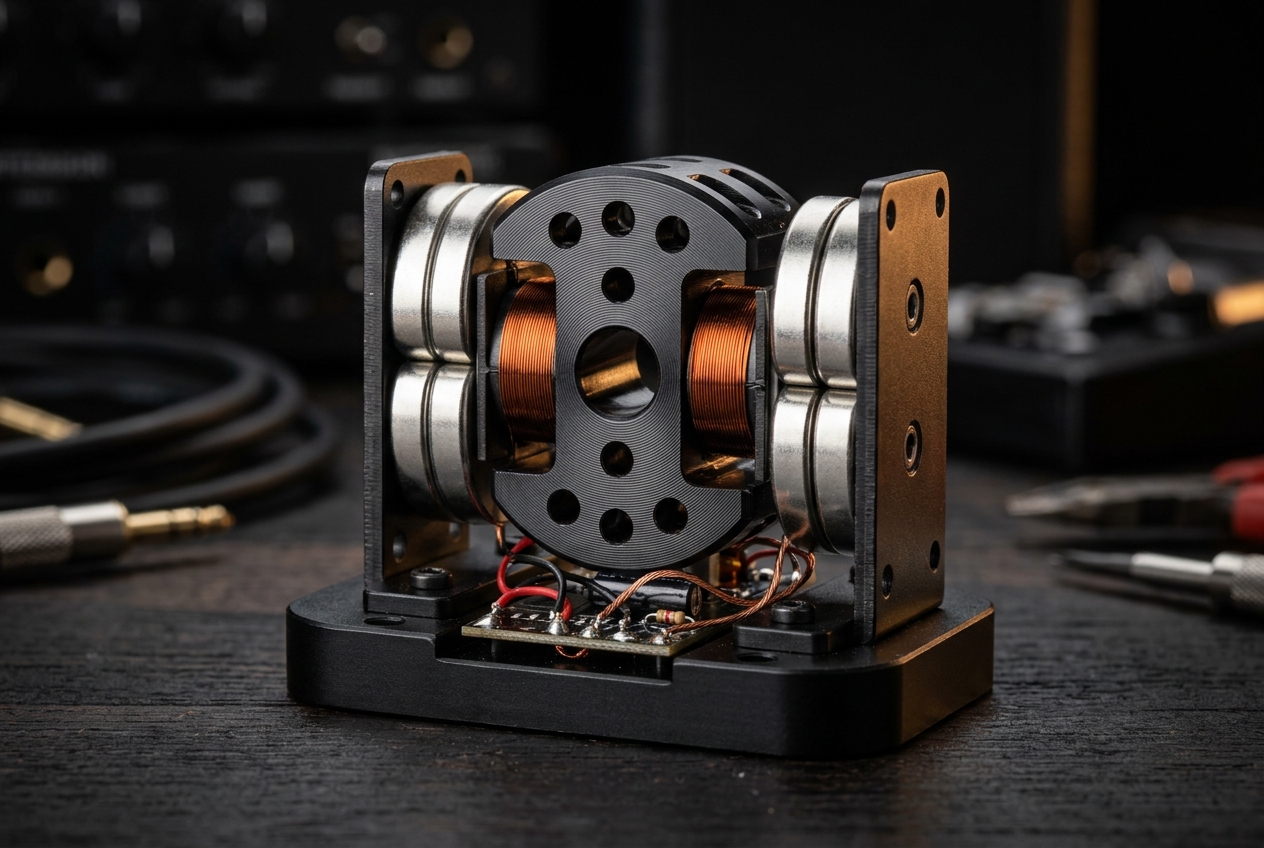
The core electrodynamic operating principle of a dual-gap symmetrical motor lies in the spatial inversion and push-pull cancellation of magnetic field vectors. A dual-gap motor assembly incorporates two distinct annular magnetic gaps positioned axially along a shared central pole structure. Two high-grade Neodymium-Iron-Boron (NdFeB N52) ring magnets are typically arranged in magnetic opposition (e.g., North-to-North facing a common high-permeability central pole piece, with return steel plates routing flux to upper and lower outer gaps). This geometry establishes two intense radial magnetic fields with diametrically opposed polarities: in Gap 1, the radial flux vector B_1 points radially outward, whereas in Gap 2, the radial flux vector B_2 points radially inward.
To interface with these opposed magnetic fields, the voice coil former carries two distinct winding sections (Coil 1 and Coil 2). These coils are wound with reversed rotational directions or wired in reverse electrical phase. When forward driving current is applied, both coil sections generate Lorentz force vectors in the exact same axial direction (F_total = F_1 + F_2). However, their spatial interaction with the magnetic fringe fields is geometrically complementary: as the former moves forward by displacement +x, Coil 1 moves out of Gap 1 toward open air, entering a decaying fringe field: Bl_1(x) = Bl_0 – α x – β x^2. Simultaneously, Coil 2 moves into the concentrated core zone of Gap 2: Bl_2(x) = Bl_0 + α x – β x^2.
When the total force factor is summed across both active coil sections, the linear asymmetry coefficients cancel out with mathematical perfection: Bl_total(x) = Bl_1(x) + Bl_2(x) = 2 Bl_0 – 2 β x^2. The first-order derivative b_1 = dBl_total/dx identically equals zero! The resulting force factor curve is entirely symmetric about the mechanical origin (x = 0), exhibiting a pristine parabolic contour governed solely by symmetrical, quadratic roll-off (-2 β x^2). Crucially, this spatial inversion simultaneously neutralizes the inductance derivative: as Coil 1’s partial inductance L_e1 drops with outward movement, Coil 2’s partial inductance L_e2 rises by an identical amount. The composite inductance gradient d(L_e1 + L_e2)/dx collapses to nearly zero (0.005 mH/mm), completely extinguishing the reluctance force F_rel and obliterating dynamic voice coil jumping.
5. Mechanical and Thermal Realization in Audiophile Headphone Drivers
Translating dual-gap symmetrical motor theory into micro-acoustic transducers—such as circumaural headphone drivers and high-output in-ear monitors—demands extreme mechanical precision and advanced material science. In full-scale loudspeaker woofers, moving masses of 40 to 120 grams easily accommodate dual heavy voice coils and thick formers. In a 40 mm or 50 mm audiophile headphone transducer, however, total moving mass M_ms must be rigidly constrained under 35 milligrams; any excess inertial mass degrades high-frequency extension, induces early diaphragm modal breakup, and rolls off ultrasonic air above 20 kHz.
To achieve dual-gap symmetry without sacrificing high-frequency transient speed, transducer engineers utilize ultra-thin polyimide (Kapton) formers etched down to wall thicknesses of just 12 to 15 microns, strategically perforated with micro-venting laser apertures between the two coil sections to relieve trapped air pressure. The voice coil windings themselves utilize high-aspect-ratio edge-wound Copper-Clad Aluminum Wire (CCAW) with rectangular cross-sections. This edge-wound configuration achieves a conductor volumetric fill factor exceeding 88%—compared to just 65% for conventional round wire—allowing engineers to generate immense magnetic coupling within compact, narrow 0.45 mm magnetic air gaps while keeping moving mass exceptionally low.
Furthermore, dual-gap voice coil topologies offer monumental thermal dissipation advantages that are virtually unknown in single-gap drivers. In a standard single-gap headphone driver, Joule heat dissipation (i^2 R_e) is concentrated within a single, narrow voice coil band. Under sustained listening at elevated sound pressure levels, heat accumulates rapidly, causing voice coil temperature to spike by 40°C to 70°C. Because the electrical resistance of copper increases with temperature (R_e(T) = R_e0 [1 + 0.00393 · ΔT]), the voice coil suffers thermal compression, dulling micro-dynamic impact and altering crossover damping. In a dual-gap motor, the voice coil surface area is distributed across two separate physical zones, doubling the convective cooling area and proximity to the aluminum chassis heatsink. This cuts thermal resistance R_th in half, ensuring unwavering dynamic linearity and absolute resistance stability even during thunderous sub-bass crescendos.
6. Psychoacoustic Realities: Intermodulation Distortion and Low-End Transparency
From a psychoacoustic perspective, the human auditory system processes even-order harmonic distortion and intermodulation distortion in fundamentally different ways. In single-tone listening tests, modest levels of second-harmonic distortion (HD2) are often partially masked by the human ear’s own internal cochlear non-linearities, leading some casual commentators to erroneously dismiss HD2 as benign or ‘warm.’ In complex, multi-tonal musical reproduction, however, motor asymmetry is utterly catastrophic. The non-linear Taylor series coefficient b_1 does not merely generate a pure octave harmonic; it acts as a mixer, modulating every simultaneously playing frequency through second-order intermodulation distortion: IMD_2 = f_2 ± f_1.
When an audiophile headphone driver reproduces a deep bass fundamental (such as a 35 Hz synthesizer drone or pipe organ pedal note) alongside delicate midrange information (such as a 1.2 kHz vocal harmonic or 2.5 kHz string overtone), single-gap motor asymmetry causes the strong 35 Hz excursion to continuously modulate the transfer gain of the midrange content. This creates harsh, dissonant sidebands at 1165 Hz and 1235 Hz that fall completely outside the psychoacoustic masking curves of the auditory critical bands. The listener perceives this intermodulation not as warmth, but as acoustic haze, loss of vocal clarity, collapsed soundstage depth, and smearing of fine spatial cues.
By eradicating b_1 and linearizing Bl(x) across a wide ±2.0 mm stroke, dual-gap symmetrical transducers eliminate the intermodulation mechanism at its electrodynamic root. The audible result is a profound acoustic revelation: bass fundamentals sound taut, pitch-accurate, and visceral, while the overlying midrange and treble remain completely uncorrupted, transparent, and holographic. Low-level reverberation tails, ambient studio room decay, and subtle micro-dynamics that were previously swallowed by excursion-induced IMD sidebands emerge with pristine, effortless fidelity, redefining the boundaries of high-end headphone reproduction.
7. Engineering Implementation Principles & Diagnostic Guidelines
- Zero-Gradient Magnetic Circuit Matching: Ensure flux densities B_1 and B_2 in opposing gaps match within ±0.6% tolerance using precision-ground Permendur (FeCoV) center pole pieces to ensure complete first-order derivative cancellation (b_1 < 0.008 T·m/mm).
- Dual Symmetrical Copper Demodulation Rings: Position twin oxygen-free high-conductivity (OFHC) copper shorting rings immediately adjacent to each magnetic gap, maintaining voice coil inductance gradient dLe/dx < 0.01 mH/mm across the entire ±2.0 mm operational envelope.
- Inertial Mass Budgeting via Rectangular CCAW: Utilize high-aspect-ratio edge-wound copper-clad aluminum wire on a 15-micron vented polyimide former to hold total moving mass Mms ≤ 33 mg for a 40 mm transducer, preserving structural piston mode bandwidth past 36 kHz.
- Mirror-Image Progressive Surround Compliance: Pair the push-pull motor with a computer-modeled liquid silicone rubber (LSR) surround whose mechanical compliance Kms(x) exhibits pure quadratic symmetry, preventing suspension asymmetry from reintroducing mechanical HD2.
- Klippel Distortion Analyzer Qualification: Validate motor prototypes using Klippel Large Signal Identification (LSI) laser vibrometry, confirming that dynamic DC displacement offset remains under 5 μm and HD2 suppression exceeds 22 dB relative to single-gap baselines at peak excursion.
The pursuit of electroacoustic perfection has always been a war against physical compromise. For nearly a century, dynamic moving-coil transducers have accepted motor asymmetry as an inevitable tax on acoustic output, relying on acoustic damping and DSP trickery to mask the resulting even-order harmonic distortion and dynamic DC drift. Dual-gap symmetrical voice coil topologies demolish this compromise, confronting the electrodynamic non-linearity at its fundamental electromagnetic root.
By synthesizing opposed magnetic flux fields, push-pull split windings, and comprehensive inductance linearization into an ultra-low-mass transducer architecture, dual-gap engineering achieves the pristine distortion profile and lightning-fast transient response of planar-magnetic drivers while preserving the explosive dynamic efficiency and deep-bass impact unique to moving-coil transducers. For acoustic engineers and discerning audiophiles alike, dual-gap motor symmetry stands as the definitive benchmark of modern transducer design.
Discuss more about this, FAQ, Announcements and Miscellaneous, over on our community.

Leave a Reply