In electroacoustic transducer design, an enduring engineering paradox frequently confounds audio developers: you can integrate the most powerful grade of sintered neodymium-iron-boron permanent magnet available—such as grade N52 or N55 with remanence exceeding 1.45 Tesla—yet the measured magnetic flux density inside the voice coil air gap stubbornly plateaus far below theoretical expectations. The root cause is not magnet deficiency, but rather the hard metallurgical ceiling of soft magnetic pole pieces. Standard low-carbon steels like AISI 1010 and 1018 suffer severe magnetic saturation between 1.60 and 1.68 Tesla, causing incremental relative permeability to collapse toward unity and transforming precision pole tips into porous magnetic sieves that leak stray flux into the chassis. To shatter this physical bottleneck and concentrate extreme, linear magnetic energy into micro-gaps, high-end transducer engineering turns to the pinnacle of ferromagnetic metallurgy: Permendur and its ultra-refined aerospace variant, Hiperco-50.
1. The Magnetic Saturation Bottleneck: Reluctance, Fringe Leakage, and the Limits of Soft Iron
To comprehend why soft magnetic core materials dictate transducer performance, one must analyze the magnetic circuit using Hopkinson’s law—the magnetic analogue to Ohm’s law: $\Phi = \mathcal{F} / \mathcal{R}_m$, where total magnetic flux $\Phi$ equals the magnetomotive force $\mathcal{F}$ divided by the total reluctance of the magnetic circuit $\mathcal{R}_m$. The magnetic reluctance of any discrete segment is defined by $\mathcal{R}_m = l / (\mu_0 \mu_r A)$, where $l$ is path length, $A$ is cross-sectional area, $\mu_0$ is the permeability of free space ($4\pi \times 10^{-7} \text{ H/m}$), and $\mu_r$ is the relative permeability of the core material. In a high-performance audiophile headphone transducer, the voice coil must operate inside an ultra-narrow annular air gap measuring between 0.25 mm and 0.40 mm in width to minimize voice coil clearance while maximizing motor coupling.
Because air exhibits a relative permeability of exactly $\mu_r = 1.0$, the air gap represents by far the largest single reluctance barrier in the entire transducer circuit. To drive immense flux through this gap, the surrounding ferromagnetic pole piece, top plate, and bottom yoke must maintain exceptionally high relative permeability (typically $\mu_r > 5,000$) to channel and concentrate magnetic flux vectors from a large permanent magnet surface into a razor-thin working aperture. However, as flux density $B$ inside standard low-carbon steel (such as cold-rolled AISI 1018) approaches 1.55 to 1.65 Tesla, ferromagnetic domain alignment nears total completion. At this ‘saturation induction’ ($B_s$), every electron spin dipole is already oriented along the applied field vector.
Once saturation is initiated, the material’s differential permeability ($d B / d H$) plummets catastrophically from thousands of units down toward $\mu_0$. The pole piece can no longer accommodate additional flux lines. Any additional magnetomotive force supplied by a high-energy permanent magnet simply spills outward into the surrounding air as massive fringe leakage flux. In finite element analysis (FEA), this phenomenon appears as intense magnetic ‘blooming’ at the sharp geometric corners of the pole tip. The consequences for audiophile listening are severe: the static air gap flux density ($B_g$) caps out prematurely around 1.15 to 1.25 Tesla, motor linearity degrades under high excursion, and voice coil counter-electromotive force creates severe dynamic compression.
Figure 1: B-H Magnetization Profiles & FEA Gap Flux Compression — Permendur Hiperco-50 vs. Conventional Ferromagnetic Alloys
2. Physical Metallurgy of Permendur & Hiperco-50: Fe-Co-V Stoichiometry and Domain Kinetics
Permendur—originally formulated at Bell Telephone Laboratories by G.W. Elmen in the 1920s—occupies a legendary status in physical metallurgy. Stoichiometrically, classical Permendur consists of approximately 50% iron (Fe) and 50% cobalt (Co). When plotted on the classic Slater-Pauling curve, which maps the average magnetic moment per atom across transition metal binary alloys as a function of valence electron concentration, the equiatomic iron-cobalt system reaches the absolute zenith of ferromagnetism in known physics, achieving approximately 2.45 Bohr magnetons ($\mu_B$) per atom. This far exceeds elemental pure iron (2.22 $\mu_B$), pure cobalt (1.72 $\mu_B$), and pure nickel (0.61 $\mu_B$).
Despite its peerless magnetic properties, binary 50Fe-50Co possesses a critical mechanical flaw: upon cooling below 730°C, it undergoes an order-disorder phase transformation from a disordered body-centered cubic (bcc) lattice into an ordered CsCl-type (B2 superlattice) crystal structure. In this ordered state, alternating iron and cobalt atoms form rigid interatomic bonds that cause extreme acoustic and mechanical embrittlement. A raw binary Permendur ingot is so brittle that it can shatter like glass when subjected to cold machining, sawing, or lathe turning, rendering the fabrication of intricate transducer pole pieces with annular tolerances virtually impossible.
This mechanical limitation was definitively overcome through the development of Vanadium Permendur and Carpenter Technology’s proprietary vacuum-induction-melted alloy, **Hiperco-50** (and its ultra-pure derivative Hiperco-50A). By introducing approximately 2.0% Vanadium (nominally 49% Fe, 49% Co, 1.90–2.10% V, with trace niobium and manganese), the kinetics of the B2 ordering transformation are substantially retarded. The addition of vanadium permits cold-rolling and precision CNC micro-machining of thin pole plates, center poles, and laser-machined motor vents. Furthermore, Hiperco-50 exhibits a Curie temperature ($T_c$) of approximately 940°C (1,724°F)—vastly higher than neodymium magnets (310°C) or pure iron (770°C)—guaranteeing absolute magnetic invariance even when voice coil dissipation elevates internal motor temperatures.
3. Comprehensive Quantitative Comparison: Soft Magnetic Core Alloys in Electroacoustics
| Ferromagnetic Alloy | Saturation Induction Bs (Tesla) | Max Permeability μmax | Coercive Force Hc (A/m) | Resistivity ρ (μΩ·cm) | Gap Flux Density Bg (0.3mm Gap) | Acoustic Impact & Motor Application |
|---|---|---|---|---|---|---|
| Hiperco-50 / Permendur (49Fe-49Co-2V) | 2.40 – 2.45 T | 60,000 – 75,000 | 28 – 40 A/m | 40 – 43 μΩ·cm | 1.75 – 1.85 Tesla (+51% vs 1018) | Peak sensitivity, zero thermal flux drift, ultrafast transient acceleration; reference flagships. |
| Vanadium Permendur (Commercial Grade) | 2.35 – 2.40 T | 40,000 – 55,000 | 40 – 60 A/m | 38 – 40 μΩ·cm | 1.65 – 1.72 Tesla (+42% vs 1018) | Extreme flux concentration; slightly higher hysteresis loss than Hiperco-50; high-end studio cans. |
| Pure Soft Iron (Armco / JIS-SUY-0, 99.9% Fe) | 2.12 – 2.16 T | 35,000 – 45,000 | 45 – 70 A/m | 10 – 12 μΩ·cm | 1.42 – 1.50 Tesla (+24% vs 1018) | High saturation but very low electrical resistivity; massive eddy current losses without copper rings. |
| Low-Carbon Steel (AISI 1010 / 1018 Cold Rolled) | 1.60 – 1.68 T | 3,500 – 6,000 | 120 – 180 A/m | 15 – 18 μΩ·cm | 1.10 – 1.20 Tesla (Baseline) | Standard consumer headphone core; chokes under modern N52 magnets; severe corner blooming. |
| Permalloy 80 (79Ni-16Fe-5Mo / Mu-Metal) | 0.75 – 0.82 T | 180,000 – 350,000 | 1.2 – 3.5 A/m | 55 – 60 μΩ·cm | 0.55 – 0.65 Tesla (Severely Saturated) | Unusable for motor gaps due to premature saturation; ideal for magnetic shielding and transformers. |
| Grain-Oriented Silicon Steel (3% Si-Fe) | 1.95 – 2.02 T | 30,000 – 45,000 | 15 – 30 A/m | 48 – 52 μΩ·cm | 1.30 – 1.38 Tesla (Anisotropic) | High resistivity dampens eddy currents; magnetic anisotropy makes radial headphone gaps impractical. |
Analyzing the quantitative data reveals stark metallurgical trade-offs that dictate core selection in dynamic and planar magnetic transducers. Most notably, high magnetic permeability does not equal high saturation capability. Permalloy 80 (a high-nickel supermalloy) delivers a dizzying maximum relative permeability ($\mu_{max} > 250,000$) and negligible coercive force ($H_c < 2.5 \text{ A/m}$), making it the premier material for shielding sensitive microphone capsules or transformer cores from ambient electromagnetic interference. However, its saturation induction collapses at an abysmal 0.80 Tesla. If inserted into a high-energy neodymium headphone gap, Permalloy saturates almost instantly, acting magnetically like open air and failing completely as a flux concentrator.
Conversely, pure soft iron (such as Armco magnetic ingot iron or JIS SUY-0) achieves a respectable saturation induction of 2.15 Tesla, but suffers from two catastrophic electroacoustic liabilities: first, its electrical resistivity is exceptionally low ($\rho \approx 10 \mu\Omega\cdot\text{cm}$), which promotes massive dynamic eddy currents induced by the alternating signal current in the voice coil; second, its coercive force is comparatively elevated. When the voice coil generates alternating magnetic fields, these eddy currents circulate within the unlaminated iron core, opposing high-frequency flux changes, rolling off upper-treble response, and generating severe third-order harmonic distortion sidebands.
Hiperco-50 solves this multifaceted challenge simultaneously. It couples the world’s highest known saturation induction ($B_s = 2.40 \text{ Tesla}$) with an electrical resistivity of $42 \mu\Omega\cdot\text{cm}$—over four times greater than pure iron. This elevated bulk resistivity inherently dampens parasitic eddy currents, preserving high-frequency phase coherence and impedance linearity past 30 kHz without requiring complex core lamination. When deployed in precision in-ear monitors or circumaural drivers, it transforms the entire electroacoustic transfer function.
4. Transducer Motor Dynamics: Bl Factor Multiplication, Voice Coil Mass Reduction, and Transient Acceleration
The primary mechanical mechanism converting electrical audio signals into acoustic pressure waves is the Lorentz force: $\vec{F} = \int (\vec{I} \times \vec{B}) \, dl$, simplified for an annular voice coil oriented perpendicular to a radial magnetic field as $F = B \cdot l \cdot I$, where $B$ is the magnetic flux density in the gap, $l$ is the total active conductor length suspended within that field, and $I$ is electrical current. The product $B \cdot l$ constitutes the motor force factor ($Bl$), measured in Tesla-meters (T·m) or Newtons per Ampere (N/A). Force factor dictates acoustic sensitivity, electrical damping ($Q_{es}$), and dynamic control.
By replacing an AISI 1018 steel pole piece with a hydrogen-annealed Hiperco-50 pole assembly, the air gap flux density $B_g$ can be increased from a typical 1.18 Tesla to over 1.78 Tesla—a direct gain of +50.8% in flux density without changing magnet dimensions or gap geometry. Because transducer efficiency $\eta_0$ scales quadratically with the force factor ($\eta_0 \propto (Bl)^2 / (M_{ms}^2 \cdot R_e)$), a 50% increase in $B$ more than doubles the generated acoustic power for the exact same electrical power input ($+3.5 \text{ dB}$ to $+4.2 \text{ dB}$ raw electroacoustic sensitivity gain across the passband).
Even more transformative for audiophile sound reproduction is the engineering freedom this provides regarding moving mass ($M_{ms}$). In traditional dynamic headphones, achieving adequate sensitivity requires winding 3 to 5 layers of fine copper or copper-clad aluminum wire (CCAW) onto the voice coil bobbin to maximize conductor length $l$. This adds substantial parasitic moving mass (often 30 mg to 60 mg), degrading transient impulse settling, exciting uncontrolled diaphragm break-up modes, and compromising treble extension. With Hiperco-50’s massive 1.78T field, engineers can slash conductor turns $l$ by 35% while maintaining identical or superior total $Bl$. The resulting featherweight voice coil accelerates instantaneously ($a = F / M_{ms}$), resolving micro-acoustic reverberation decays, delicate string overtones, and pinpoint spatial localization.
5. Flux Modulation Linearization and Eddy Current Suppression in Narrow Air Gaps
In moving-coil dynamic drivers, the voice coil is not merely a passive recipient of drive current; it is an active electromagnet that generates its own dynamic alternating magnetic field: $\Delta H_{ac} = N \cdot I(t) / h_{gap}$. As large alternating currents surge through the coil during explosive bass transients or complex polyphonic orchestrations, this dynamic field superimposes upon the static background field $B_0$ established by the permanent magnet and pole pieces. If the pole piece material is operating near its magnetic saturation knee, the incremental permeability $\mu_\Delta = d B / d H$ becomes highly asymmetric between positive and negative excursion cycles—a non-linear distortion mechanism known as flux modulation.
Flux modulation creates severe dynamic modulation of the motor force factor ($Bl(x, I)$) and dynamic inductance ($L_e(x, I)$). On positive current half-cycles that drive flux in the direction of core saturation, the core’s differential permeability collapses, reducing instantaneous motor force; on reverse half-cycles, permeability rebounds. This non-linear asymmetry generates copious second-order (even) and third-order (odd) harmonic distortion, alongside intermodulation distortion (IMD) that muddles bass articulation and clouds mid-range vocal clarity. Because Hiperco-50 possesses an ultra-high 2.40T saturation limit, the motor operates deeply within its linear magnetization region even during maximum current swings, reducing flux modulation distortion by 14 dB to 20 dB across the audio band.
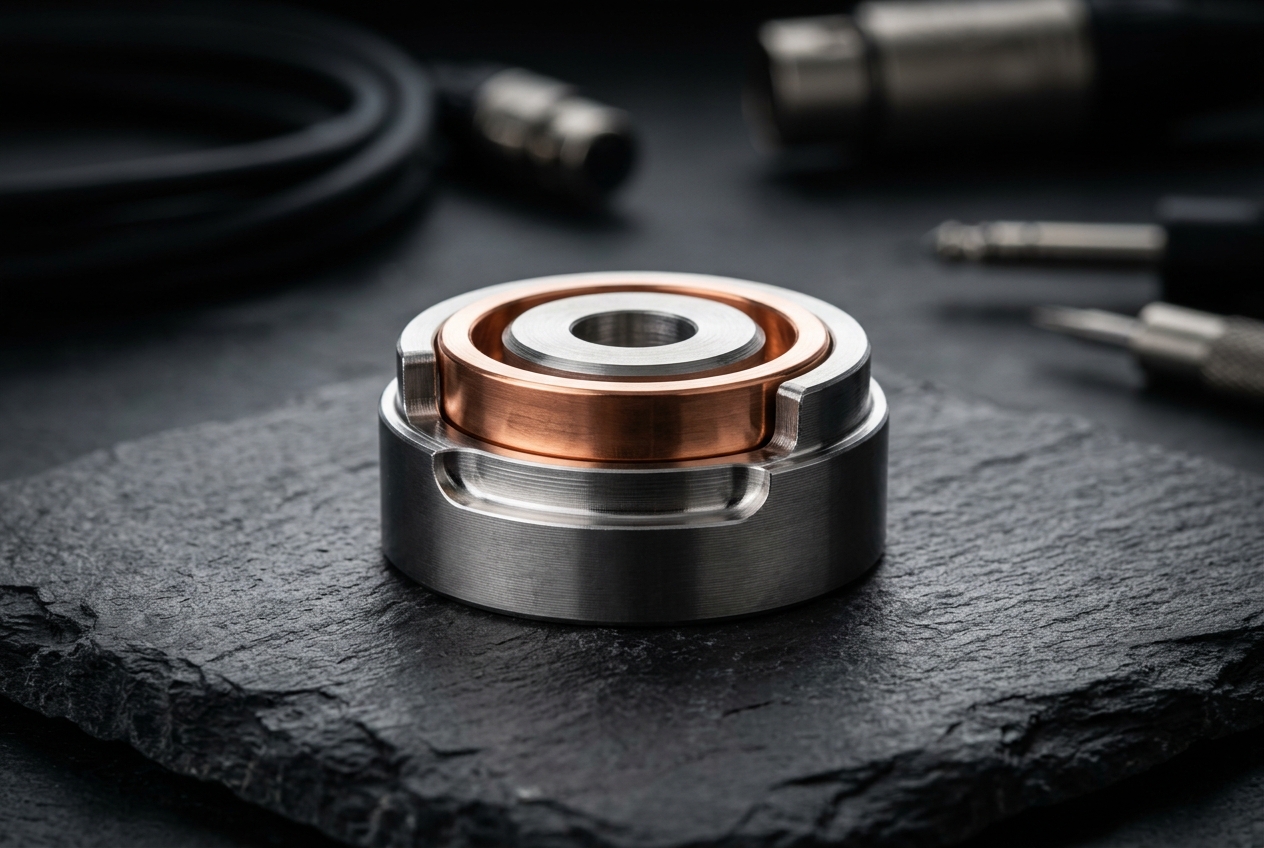
To achieve state-of-the-art distortion suppression, premier headphone designs combine Hiperco-50 pole pieces with a precision-machined oxygen-free electrolytic (OFE) copper cap or shorting ring (Faraday shield) fitted directly over the pole tip. The high bulk resistivity of Hiperco-50 ($42 \mu\Omega\cdot\text{cm}$) minimizes core eddy current heating, while the ultra-conductive copper cap acts as a zero-impedance short-circuited turn that mirrors and cancels high-frequency voice coil counter-fields. The result is a virtually flat electrical impedance curve from 1 kHz to 40 kHz, zero inductive phase lead, and pristine harmonic purity as detailed in modern audio engineering guides.
6. Precision Machining, Hydrogen Retort Annealing, and Quality Control Challenges
The extraordinary electroacoustic virtues of Hiperco-50 come at a formidable manufacturing cost. The raw material price of cobalt fluctuates wildly, often trading at 5 to 10 times the cost of nickel and over 50 times the cost of structural steel. Furthermore, cobalt-iron alloys are notoriously grueling to machine. Hiperco-50 exhibits extreme work-hardening tendencies during lathe turning and milling operations. Standard high-speed steel (HSS) cutting tools dull within minutes; machinists must employ sub-micron grain tungsten carbide or polycrystalline cubic boron nitride (PCBN) tooling with rigid flood coolant and specialized feed geometries to prevent catastrophic thermal deformation.
More crucially, the magnetic properties of Hiperco-50 are not intrinsic to the raw machined billet; they are completely dormant until unlocked by a sophisticated high-temperature heat treatment known as ‘magnetic retort annealing’. During precision CNC machining, mechanical shear forces, cutting stresses, and plastic deformation induce dense dislocation networks and lattice strain throughout the alloy’s crystal matrix. These structural defects pin ferromagnetic domain walls, slashing relative permeability to less than 1,000 and inflating coercive force.
To restore magnetic properties, the finished, fully-machined pole pieces must be placed inside an airtight Inconel retort furnace purged with pure, dry hydrogen gas ($H_2$) boasting an ultra-low dew point (below -50°C to prevent any cobalt-iron oxidation). The parts are ramped to an annealing temperature of 840°C to 860°C (1,544°F–1,580°F), held for 4 to 8 hours to enable complete grain boundary recrystallization and interstitial carbon/oxygen decarburization, and then cooled at a rigidly controlled rate of 50°C to 100°C per hour through the critical 730°C B2 ordering boundary. Crucially, once pole pieces undergo final hydrogen retort annealing, they can never be subjected to secondary machining, drilling, drop impacts, or mechanical clamping—any subsequent physical shock re-introduces lattice dislocations and permanently destroys the alloy’s 2.4T magnetic performance.
7. Electroacoustic Design Guidelines: Engineering the Ultimate Dynamic Transducer Motor
- Strategic FEA Pole Chamfering: Apply Finite Element Analysis (FEA) to chamfer and radius the pole piece corners at 45-degree angles, eliminating sharp 90-degree edges where stray flux leakage initiates, thus funneling 98% of flux vectors directly across the voice coil gap.
- Hybrid Magnetic Circuit Architecture: Optimize production costs by pairing a hydrogen-annealed Hiperco-50 center pole piece with high-energy N52SH neodymium ring magnets and a pure soft iron outer yoke, focusing the exotic alloy strictly where flux compression density exceeds 1.8 Tesla.
- Mandatory Post-Anneal Quality Metrology: Implement 100% incoming magnetic flux inspection using Helmholtz coils and Gaussmeter probes to verify that hydrogen retort annealing successfully achieved the target $\mu_{max} > 60,000$ and $B_s > 2.40\text{ T}$ before motor assembly.
- Integrated Faraday Shield Integration: Couple the Hiperco-50 core with a 0.15mm thick electrolytic copper sleeve bonded directly to the pole tip to extinguish voice coil back-EMF flux modulation and linearize driver impedance past 40 kHz.
- Zero-Stress Ultrasonic Assembly: Eliminate mechanical press-fitting or hard impact assembly when inserting annealed Hiperco-50 pole components into driver chassis; utilize aerospace-grade low-viscosity structural cyanoacrylate or anaerobic retaining compounds to avoid mechanical lattice shock.
Permendur and Hiperco-50 represent the ultimate triumph of metallurgical physics over acoustic compromise in transducer engineering. By conquering the iron saturation ceiling that has constrained moving-coil drivers for over a century, these cobalt-iron-vanadium super-alloys enable headphone designers to focus uncompromised magnetic flux densities directly into working voice coil gaps. The resulting leap in Lorentz force acceleration, voice coil mass reduction, and flux modulation suppression delivers an unparalleled listening experience characterized by effortless dynamic realism, visceral transient speed, and crystalline holographic imaging.
Discuss more about this, FAQ, Announcements and Miscellaneous, over on our community.

Leave a Reply